

Wakesurfing is safest when four basics are covered:
- The boat’s propulsion is designed for surfing, which in practice usually means an inboard with the propeller under the hull.
- No one rides the swim platform while the engine runs.
- The surfer wears a Coast Guard–approved life jacket.
- A spotter watches the rider at all times.
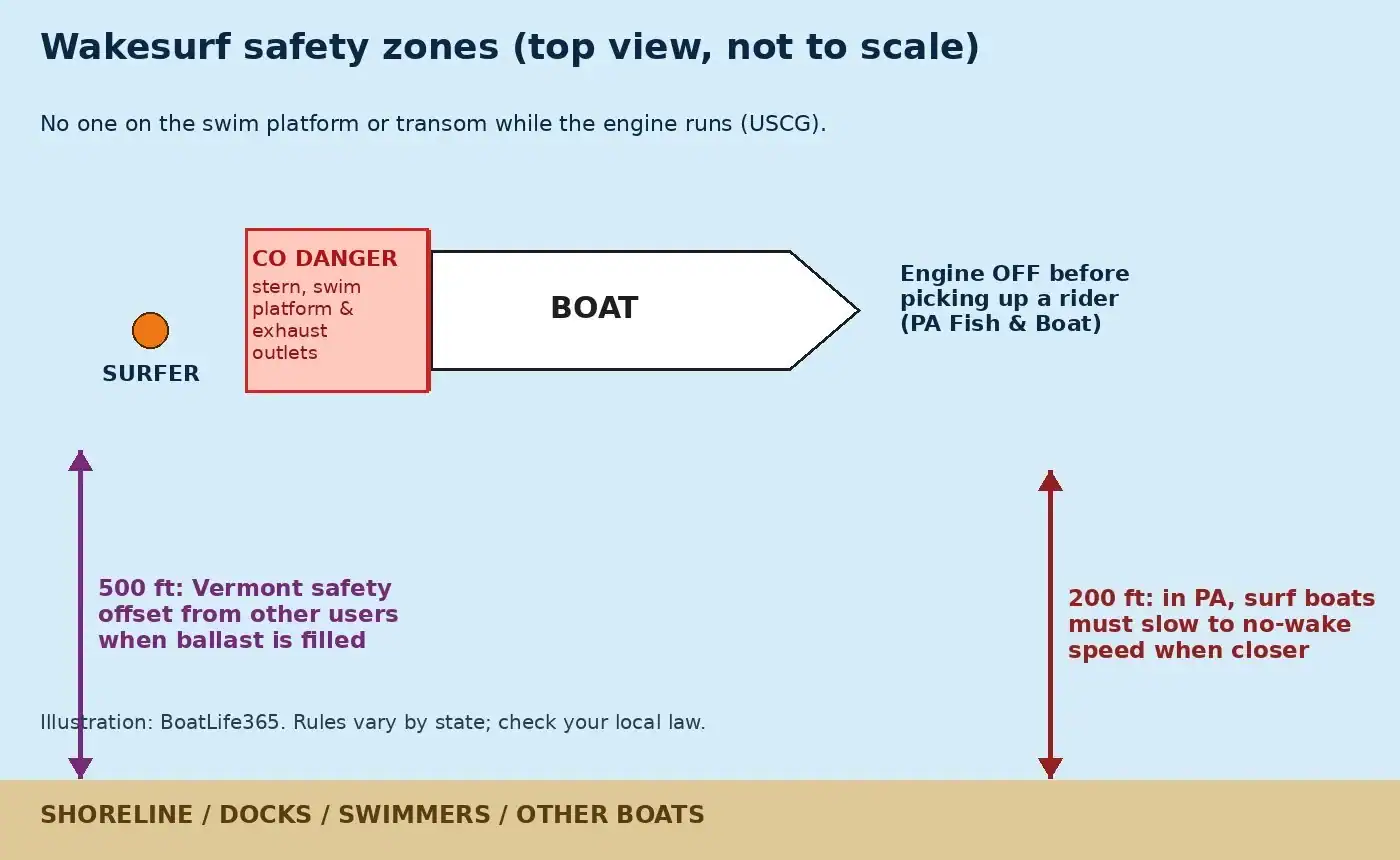
Several states now write these into law. Pennsylvania, for example, bans wakesurfing behind outboards, sterndrives and jets, and requires surf boats to slow to no-wake speed within 200 feet of shore. Below are the rules, the carbon monoxide numbers, and how ballast and capacity fit together.
Some links on this page are paid affiliate links. If you purchase through them, BoatLife365 may earn a commission. As an Amazon Associate I earn from qualifying purchases.
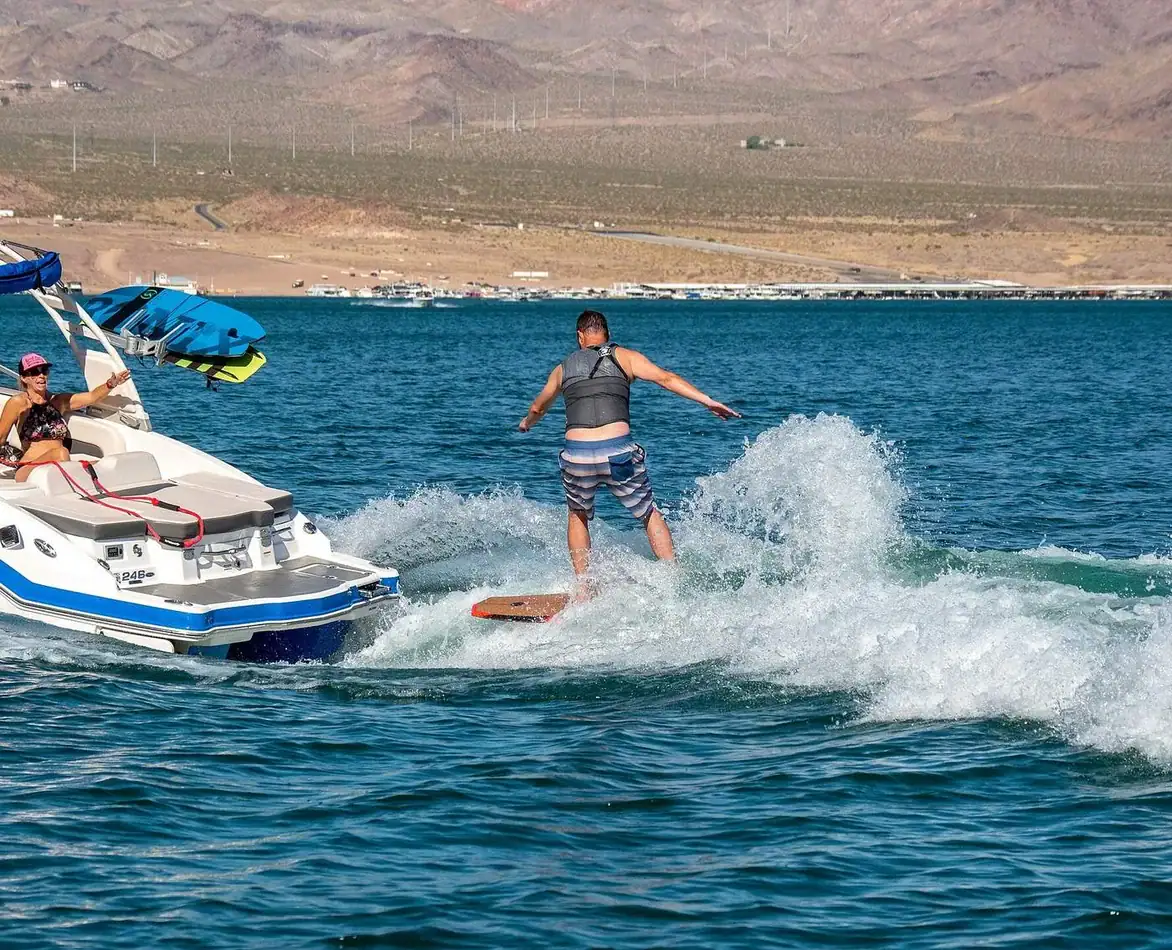
Wakesurfing is different from skiing or wakeboarding. The rider drops the rope and surfs close behind the transom, at slow speed, right where the propeller, the exhaust and the boat’s extra ballast weight all matter most. That’s why the safety rules focus on the stern of the boat.
Wakesurfing laws: what four states require
There’s no single federal wakesurfing law. States set the rules, and several now name wakesurfing specifically. Here’s what four state laws and rules say, checked on each state’s official site:
| State | Rule | Source |
|---|---|---|
| Pennsylvania | Surf boats must be at slow, no-wake speed within 200 ft of shorelines, docks, launch ramps, swimmers, anchored or moored boats and other towed riders. Outboard, inboard/outboard (sterndrive) and water-jet boats are prohibited from towing anyone in or on the wake. Life jackets are required, and inflatables aren’t allowed. A competent observer is required. Riders count toward the boat’s capacity. No towed sports between sunset and sunrise. | PA Fish & Boat Commission |
| New Hampshire | Surfing is not allowed behind an outboard, inboard/outboard or water jet unless the propulsion system is designed by the manufacturer for that activity. An observer aged 13 or older is required. A Coast Guard–approved PFD is required. No wakesurfing between sunset and sunrise. | RSA 270-D:3 |
| Minnesota | Creating a wake for a surfer requires an observer or a wide-angle rear mirror. No wakesurfing from a half hour after sunset to sunrise. The DNR adds that wake damage is treated like collision damage, and suggests staying at least 200 ft from shore (not a legal minimum for boats). | Minn. Stat. 86B.315; MN DNR |
| Vermont | Since June 11, 2026, wakesports on inland lakes may happen only inside designated zones of at least 100 acres that are 500 ft from shore, 20 ft deep, 200 ft wide and 3,000 ft long. There’s a 500-ft safety offset from other users when ballast is filled, and ballasted boats must be decontaminated between waterbodies. | Vermont DEC |
Local rules can be stricter. Minnesota’s DNR, for example, points boaters to local surface-use ordinances. Always check the specific lake before you surf.
Why the propeller rule matters
Wakesurfers ride close behind the boat, often within reach of the swim platform. On an outboard or a traditional sterndrive, the propeller sits at the stern, close to the rider. That’s the reason Pennsylvania bans those drives for wakesurfing.
New Hampshire takes a different approach. It allows outboards, sterndrives and jets only if the maker designed the propulsion for surfing. If you’re not sure whether yours qualifies, check your owner’s manual and your state’s rule before you surf.
Whatever you drive, Pennsylvania’s Fish & Boat Commission gives a simple rule for picking up riders: turn the engine off before you pick a rider up from the water.
Carbon monoxide: the hidden wakesurfing hazard
Wakesurfing happens at low speed, right behind the transom, which is exactly where exhaust gathers.
The CDC’s National Institute for Occupational Safety and Health (NIOSH) has evaluated this. It lists wake surfing among the towed sports where CO exposure can happen, and says exposure depends on distance behind the boat, height above the water and speed.
In one NIOSH evaluation of two ski boats, CO at the stern of the idling boat with a standard transom exhaust peaked at 1,089 ppm. With a side exhaust it peaked at 153 ppm. For context:
- NIOSH’s ceiling limit for CO, which should never be exceeded, is 200 ppm.
- NIOSH’s “immediately dangerous to life and health” level is 1,200 ppm.
Every transom-exhaust reading NIOSH took at the stern, at idle and at 5, 10 and 15 mph, was over the 200 ppm ceiling.
The National Park Service has seen the consequences. In 2009, two 9-year-old girls lost consciousness from carbon monoxide while “teak surfing” behind a ski boat on Jackson Lake in Grand Teton National Park. Teak surfing means holding onto the swim platform. Both girls were revived. The park notes that teak surfing is illegal in all national park units and that CO from boats can be over 150 times higher than car exhaust.
The Coast Guard’s CO guidance is direct:
- Never sit, teak surf or hang on the back deck or swim platform while the engines are running.
- Know where your exhaust outlets are, and keep everyone away from them.
- Treat “seasickness” symptoms as possible CO poisoning, and get the person into fresh air.
- Install and maintain CO alarms inside the boat.
Boat builders have responded with exhaust designs:
- MasterCraft lists underwater exhaust as standard on its XT22.
- Nautique says the standard Surf Pipe on its G23 takes engine emissions down into the prop stream so they bubble up behind the surfer.
These help, but they don’t change the Coast Guard rule. Keep the platform clear while the engine runs.
If your surf boat has a cuddy, head or any enclosed space, a marine-listed 12-volt alarm such as the Safe-T-Alert 62 Series marine CO alarm follows the Coast Guard’s advice to install CO alarms inside the boat. The listing says it’s UL 2034 Marine Use listed. Have a qualified installer wire it to your boat’s system.
Ballast, capacity and how many people a surf boat can carry
Surf boats make their wave by sinking the stern with water ballast. The ballast numbers are big, and they’re listed separately from the boat’s passenger capacity. Here’s what three popular 22–23 ft wake boats list on their makers’ official spec pages:
| Boat | Length | Dry weight | Max persons | Weight capacity | Max ballast |
|---|---|---|---|---|---|
| Malibu Wakesetter 23 LSV | 23 ft | approx. 5,700 lb | 15 | 2,115 lb | 4,435 lb (factory) |
| MasterCraft XT22 | 22 ft 4 in | 5,485 lb | 16 (seating) | 2,400 lb | 3,500 lb |
| Super Air Nautique G23 | 23 ft 3 in | approx. 6,300 lb | 16 | 2,500 lb | 3,600 lb (with supplemental) |
What these numbers tell you:
- The person count assumes light people. Divide weight capacity by max persons and you get about 141 lb per person on the 23 LSV (2,115 ÷ 15), 150 lb on the XT22 and about 156 lb on the G23. If your crew are adults averaging 190 lb, the 23 LSV’s 2,115 lb fills up at 11 people, not 15. Gear, coolers and boards count too. Our bowrider vs. deck boat guide covers how layout affects capacity on smaller boats.
- Surfers count as passengers. Pennsylvania says towed riders are passengers and count toward the boat’s total capacity, so a boat that’s full when everyone is aboard has no room for the surfer.
- Ballast is a separate figure. The makers list it apart from weight capacity. Check your owner’s manual for how much ballast, and which aftermarket ballast bags if any, the builder approves. Don’t stack extra ballast past what the manufacturer allows.
Which wake boat brand has the best surf system?
There’s no official ranking. Each builder sells its own system (MasterCraft calls its system SurfStar, for example), and wave quality is subjective.
What you can compare objectively are published specs (maximum ballast, weight capacity and exhaust design) plus how the boat fits your state’s rules. If you’re looking at jet-drive options, read our guide to jet boats for wake surfing first. Remember that Pennsylvania and New Hampshire both restrict surfing behind water-jet boats.
Ballast and invasive species
Ballast tanks hold lake water, and they can move invasive species from one lake to the next. Vermont now requires ballasted boats, including wake boats, to be drained “to the fullest extent practicable” after leaving state waters. A boat last launched at a different waterbody must have its engine, ballast system, pumps and bilge drained and flushed with low-pressure hot water before it enters a new one. Even where it isn’t required, draining and drying ballast between lakes is a good habit.
Wakesurf safety checklist
- Confirm the boat’s propulsion is legal and designed for wakesurfing in your state.
- Check the lake’s rules: distance from shore, local zones and daylight hours.
- Count everyone aboard, including the surfer, and check the total against the capacity in pounds as well as persons.
- Fill ballast only to the manufacturer’s limits.
- Put a non-inflatable, Coast Guard–approved life jacket on every rider. See how to put on a life jacket in the water.
- Assign a spotter, who must be 13 or older in New Hampshire.
- Keep everyone off the swim platform and transom while the engine runs.
- Shut the engine off before picking up a rider.
- Treat headache, dizziness or nausea as possible CO exposure. Move the person to fresh air and get medical help.
Safety note
Carbon monoxide is colorless and odorless. NIOSH notes that at high exposure levels, a person can lose consciousness without other symptoms first. In the water, that can mean drowning. If anyone near the stern feels unwell, stop the engine, get them into fresh air and call for help. The rules in this article are summaries. Read your state’s current law before you go out.
FAQ
Can you wakesurf behind an outboard or a sterndrive?
Not in Pennsylvania, where outboards, inboard/outboards and water jets are prohibited from towing anyone in or on the wake. In New Hampshire, it’s allowed only if the manufacturer designed the propulsion system for wakesurfing. Otherwise the propeller is too close to the rider.
How far from shore do you have to be to wakesurf?
It depends on the state:
- Pennsylvania requires slow, no-wake speed within 200 ft of shorelines, docks, swimmers and other boats.
- Vermont limits inland-lake wakesports to zones at least 500 ft from shore.
- Minnesota has no required distance for boats, but its DNR recommends at least 200 ft and more when you’re making enhanced wakes.
Is carbon monoxide really a danger when wakesurfing?
Yes, especially at the stern and at low speed. NIOSH measured CO peaks up to 1,089 ppm at the stern of an idling ski boat with transom exhaust, far above its 200 ppm ceiling limit. The Coast Guard says never to sit or hang on the swim platform while engines run.
Do wakesurfers count toward boat capacity?
In Pennsylvania, yes. The Fish & Boat Commission says towed riders are passengers and count toward the boat’s total capacity.
Can you wakesurf at night?
No, in all three states that set hours. Minnesota bans it from a half hour after sunset to sunrise, New Hampshire between sunset and sunrise, and Pennsylvania bans boat-towed watersports between sunset and sunrise.
Sources
- Pennsylvania Fish & Boat Commission, Boat-Towed Watersports: pa.gov
- New Hampshire RSA 270-D:3: gc.nh.gov
- Minnesota Statutes 86B.315: revisor.mn.gov; MN DNR, Own Your Wake: dnr.state.mn.us
- Vermont DEC, Wakeboating and Wakesports in Vermont: dec.vermont.gov
- CDC/NIOSH Engineering Controls Database, Recreational Boats: Carbon Monoxide Exposure: cdc.gov
- U.S. Coast Guard, Carbon Monoxide Protection: uscgboating.org
- National Park Service, Grand Teton release 09-53: nps.gov
- Malibu Wakesetter 23 LSV specifications: malibuboats.com
- MasterCraft XT22 specifications: mastercraft.com
- Super Air Nautique G23 specifications: nautique.com