

To reduce water pooling on a boat cover, correct the fit and use compatible supports and tie-downs so the fabric sheds rain instead of forming low pockets. Raising the center alone may leave other areas unsupported. Start with the cover maker’s instructions, not a universal pole height or DIY frame recipe.
Manufacturer guidance reviewed October 25, 2026. The original observation below is retained from the article published December 5, 2019; this update does not claim new hands-on testing.
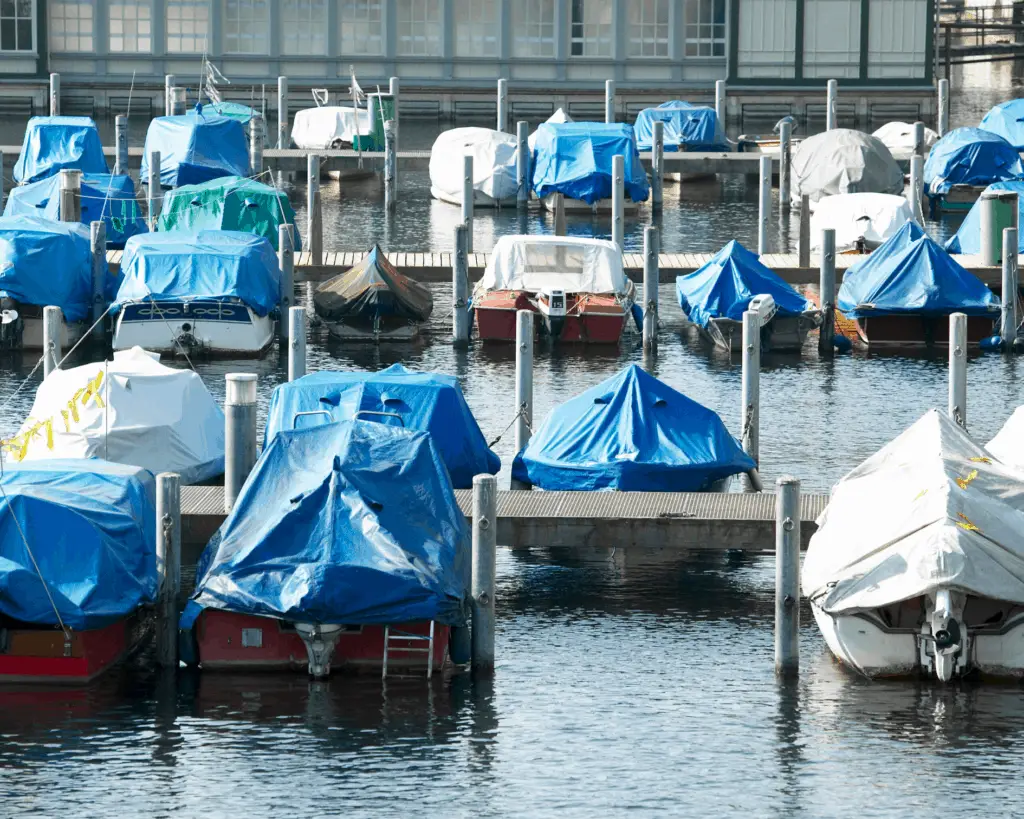
Last week I was doing some work on a boat storage yard and noticed a lot of boats with covers that have pools of water gathered in them. Since I did not want the same thing happening to me, I did thorough research on how to prevent the same from happening to my boat’s cover.
Find the low pockets before choosing more support
Check that the cover matches the boat and is installed in its intended position. Excess material, loose attachments or a shifted support can leave places where water collects. Westland’s pooling guide identifies fit, tension and support as related parts of the problem—not separate guarantees that one accessory will solve every case.
- Fit: look for loose pockets and check the cover’s placement before tightening straps.
- Support: follow the maker’s layout for poles, bows, straps or another compatible system so water has a path off the cover.
- Contact points: use the specified padding or reinforcement where the cover meets projections, and inspect for chafing.
- Condition: look for damaged fabric, seams and fasteners. Recurring sagging may need a fit or support correction rather than simply more tension.
Secure the cover as directed, without treating harder strap tension as a cure for a poor fit. Carver’s care guidance calls for proper support, tie-downs and protection at sharp contact points. It also distinguishes care of the fabric’s water repellency from preventing standing water; a treatment is not a replacement for correcting a sagging pocket.
Choose a support that matches the cover and boat
A support pole with straps, a bow system or a purpose-built frame can suit different layouts. Check the required height, support locations and attachment method against the cover’s instructions. No option is automatically the cheapest, easiest or best for every boat.
Some covers use a purpose-designed suspension system. Confirm compatibility and attachment instructions with the cover and tower manufacturers before using one. The existence of a ski tower does not establish that an improvised line or attachment point is suitable.
For a custom frame, ask the cover maker or a marine-canvas professional to assess the boat, cover, attachments and expected storage conditions. Boat length alone does not establish how much tubing is needed. This article does not prescribe a generic PVC diameter, an EMT quantity or a structural load rating for a homemade frame.
The original Camco product example
The original article featured the Camco 41970 Boat Cover Support Kit. Camco’s published catalog entry lists a height range of 30–50 inches in 2.5-inch steps and a 50-foot nylon strap assembly, described as fitting most boats up to 22 feet. These published specifications are not a fit guarantee or confirmation of current availability; check the exact model’s current instructions and the layout of your boat.
The existing video is retained below as part of that original product example. It is not a substitute for the instructions supplied with your particular equipment.
Here is a link to the original Amazon product reference. This update has not verified its current seller, stock, price or package contents, and it is not a new buying recommendation.
A storage support system does not by itself establish that the cover and supports may remain fitted while towing. Confirm that use in the instructions for both the cover and support system; no trailering rating is established here.
Custom canvas and shrink wrap need a complete plan
If you use a canvas maker or shrink-wrap service, confirm what is included: support structure, attachment points, ventilation, access for checks and instructions for later setup or removal. Do not assume a custom cover or wrapping quote includes a frame.
For shrink wrap, Dr. Shrink’s manufacturer guidance explains that support, ventilation and access doors are parts of the installation. Ventilation allows moisture to escape; it does not guarantee that the interior will stay dry or free of mildew. Heat-shrink work involves fire and burn risks, so this article is not a DIY heating or installation guide.
Shrink wrap is not necessarily impossible to reuse. Mercury Marine advises asking a marine-service professional whether a particular cover can be removed for reuse. If it cannot, check whether a local recycling program accepts the material. Neither reuse nor local recycling availability should be assumed.
Inspect the setup and care for the cover
A fitted cover still needs follow-up. Westland’s storage guidance recommends checking fit, support, ventilation and condition during storage. Inspect periodically and after substantial rain or wind when conditions are safe; the timing should reflect the weather, storage arrangement and manufacturer’s instructions.
- Look for standing water, new slack, slipped supports and loosened ties.
- Check seams, fasteners and protected contact points for wear.
- Keep intended vents unobstructed and allow the boat and cover to dry.
- Follow the fabric maker’s cleaning instructions and let the cover dry before folding it for storage.
If water keeps collecting in the same area, correct the fit or support layout with the maker or canvas professional. Do not assume an ordinary cover or homemade frame is rated to carry accumulated rain, snow or ice.
Bottom line
Start with the right fit, compatible support and proper attachment—not a blanket tubing recipe or an accessory ranking. Keep a runoff path, protect the fabric and check the setup through the storage period. If the same pocket returns, address that specific problem rather than just tightening the cover harder.