

Dry stack fits a Florida boater who usually uses the same waterway, can work within the marina’s launch schedule, and wants staff to handle launching. Trailer storage fits a boater who needs different ramps, early or late trips, or easier access for permitted maintenance. Start with whether the boat and your normal outing fit. Compare the full storage-and-access budget only after both options pass those tests.
A rack near your favorite fishing grounds can remove towing and ramp work from ordinary trips. It can also turn a spontaneous evening outing into a scheduling problem. A trailer gives you more control over where you launch, but you still need a suitable tow setup, usable storage access, and an open ramp.
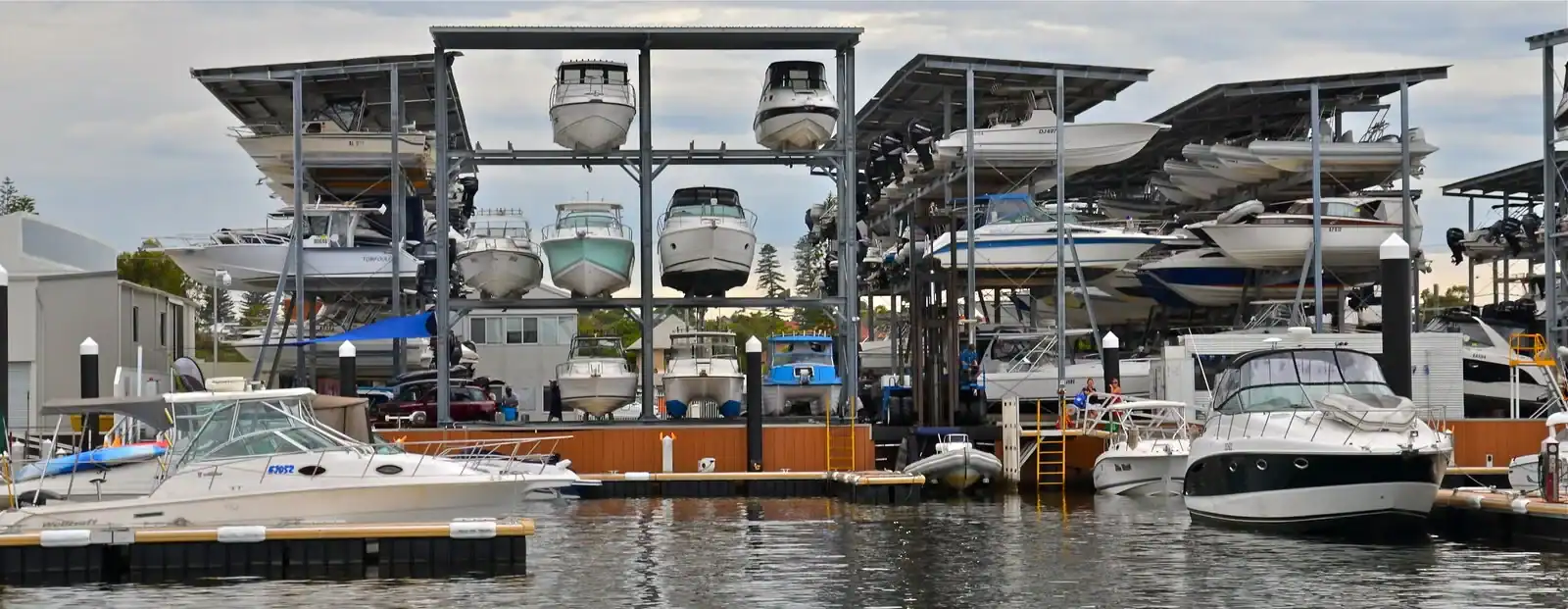

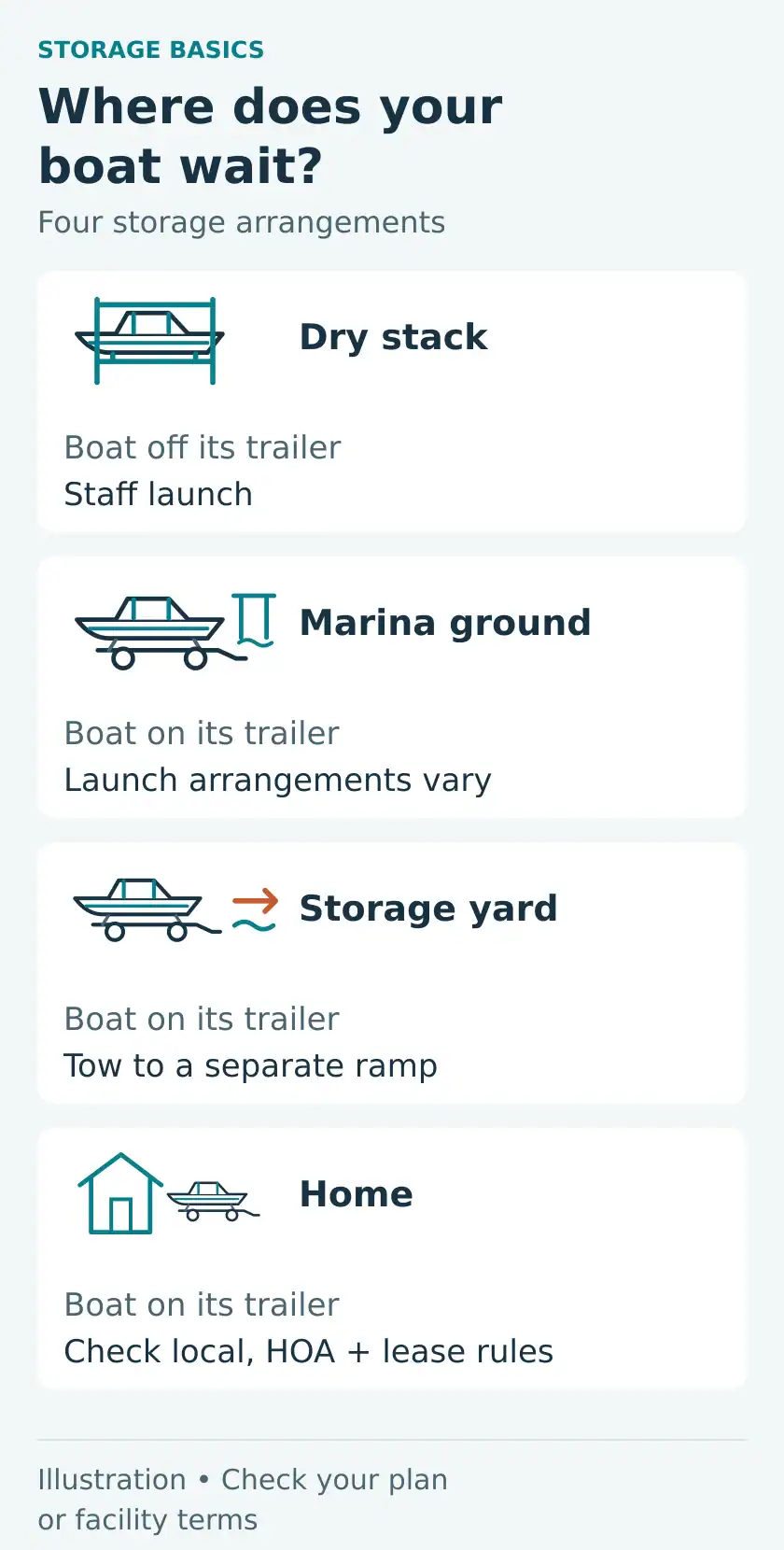
First, make sure you are comparing the same kind of storage
- Dry stack or rack storage: The boat rests on a rack, off its trailer. Staff move it to and from the water. Ask whether your assigned rack is enclosed, roof-covered with open sides, or outdoors; those are different arrangements.
- Marina ground storage on your trailer: The boat stays on its trailer. You or marina staff launch it at the site. This can reduce routine road towing without eliminating trailer ownership.
- A rented trailer pad or storage yard: You park the boat on its trailer and tow it to a separate ramp. Gate hours and ramp hours are two separate checks.
- Home trailer storage: You keep the boat on your property, subject to applicable local, HOA, and lease restrictions. Include the trailer’s full footprint and room to maneuver, not just the hull length.
A wet slip keeps the boat in the water. A boat lift is another arrangement. Neither is the rack-versus-trailer comparison below, and a marina’s 24-hour wet-slip access does not establish 24-hour forklift service.
Which option fits your actual boating routine?
| Your usual outing | Start by comparing | The deciding check |
|---|---|---|
| Planned daytime trips from one waterway | Dry stack | First launch, last retrieval, queue, and total drive time |
| Predawn fishing or late returns | Self-launch trailer storage | Both the storage gate and chosen ramp must be usable |
| Different ramps or trailered vacations | Trailer storage, or rack plus retained trailer | Trailer parking and transfer fees |
| Occasional trips; suitable truck and permitted home space already available | Home trailer storage | Annual carrying costs divided by actual outings |
| No suitable tow vehicle or available driver | Dry stack or tractor-assisted ground storage | A workable plan for transport, service, and storms |
| Frequent hands-on maintenance | Permitted home or ground storage | Allowed jobs, access hours, and outside-mechanic rules |
| Tall, wide, or heavy boat | Boat-specific admission check first | Actual dimensions, loaded weight, and handling compatibility |
Test the schedule before the price
Write down two trips you actually want to take: your ordinary outing and the awkward one. For example, “Saturday, leave the dock at 6 a.m., return at 10 p.m.” is more useful than asking whether a marina is open on weekends.
For each trip, check the booking deadline, first launch, last launch, last retrieval, and any overnight holding-dock arrangement. A prior-day launch may solve an early departure only if the marina permits it and has space. A late return may leave the boat afloat until staff can retrieve it. Ask when that will be, particularly before a closed day.
Also test a short-notice trip: if it is 3:30 p.m., the required notice is one hour, and the last launch is 4:15 p.m., that outing does not fit the published schedule. This is a timing example, not a promise about any operator’s exceptions.
For a trailer, trace the whole route: home → storage yard, if needed → ramp → parking → retrieval → storage. A 24-hour gate cannot help if the ramp closes earlier. Some ramps do offer overnight access: Tampa lists Davis Island Seaplane Basin and Picnic Island Park as open 24/7. That does not guarantee a parking space or suitability for your boat. Check the chosen ramp before traveling. City of Tampa ramp listings.
Compare time from leaving home to getting home again. Include towing preparation, detours, launch queues, gear loading, cleanup, and returning the trailer. Do not assume rack storage saves a particular number of minutes without checking your route and the actual service arrangement.
A boat that fits the advertised length may still not fit the rack
Get written acceptance for the boat’s exact configuration. A model name is not a measurement. Give the operator these four items:
- Length overall: Ask which projections count, including the outboard, swim platform, anchor, or pulpit, and whether billing rounds up.
- Beam: Confirm the boat’s actual width against both rack space and handling limits.
- Storage height: Include the T-top, tower, windshield, and antennas. If something folds, agree who folds it and which configuration the quote assumes.
- Loaded handling weight: Include the installed engines, fuel, water, batteries, and gear. Do not substitute a brochure’s bare-hull figure.
Ask the marina to confirm compatibility with the hull, lifting/support arrangement, and underwater fittings. Meeting a published maximum length does not establish acceptance. Cape Marina’s published terms, for example, make dimensions, weight, configuration, and handling suitability separate considerations. Cape Marina storage terms, section 15.
Trailer storage has its own admission test. Verify the loaded combination against the ratings for your particular vehicle, hitch, and trailer; passengers and cargo matter too. Ford’s guidance distinguishes towing capacity, payload, axle ratings, and combined weight. Use your own manufacturers’ manuals and labels rather than a generic “this truck can tow it” claim. Ford towing guidance.
Check home-storage permission at your address before budgeting zero rent. For example, Miami-Dade’s residential boat rules apply to unincorporated Miami-Dade County, not all of Florida. They address size, placement, and prohibited work. Your city, HOA, or lease may add different restrictions. Miami-Dade residential boat-storage guidance.
Compare the budget per completed outing
Ask each provider for a boat-specific, itemized quote. Then use the same period for every option:
Storage-and-access budget per outing = (fixed costs for the period + all access-related trip costs) ÷ completed outings.
For seasonal boating, an annual comparison is usually more revealing: include every month you pay for, including months without a trip. Count fuel, parking, or charged movements from canceled or aborted visits in the numerator even when no outing was completed. With zero completed outings, report the carrying cost; cost per outing is undefined.
A fully hypothetical example
Every dollar input below is invented to demonstrate the calculation. These are not marina quotes, Florida averages, or estimates for your boat. The rented-pad option is a separate fictional storage yard, not an add-on to the rack plan.
- Rack: $450 a month for storage, including all modeled launches and rinse/flush service, plus a $60 monthly allowance for keeping the empty trailer elsewhere, including its parking and upkeep. Fixed monthly budget: $510.
- Rented trailer pad: $150 a month for the pad plus a $30 trailer-upkeep/registration allowance. Fixed monthly budget: $180.
- Home trailer storage: No added storage rent, plus the same $30 trailer allowance. Fixed monthly budget: $30.
- Driving to the rack: 20 round-trip miles at 25 mpg, with road fuel at $4 per gallon: $3.20 per outing.
- Either trailer option: 30 total round-trip towing miles at 10 mpg, with road fuel at $4 per gallon, plus $12 ramp/parking: $24 per outing. Include a storage-yard detour in your own mileage.
The fictional rent figures already include storage taxes and mandatory recurring fees. The tow vehicle and trailer are already owned. The upkeep allowances are budget reserves, not bills already paid; the rack’s $60 includes its trailer allowance, so do not add the $30 again. This example assumes no additional tolls, insurance differences, handling charges, or storm-transport costs. Those zeroes are assumptions, not things to expect from a real contract.
| Completed outings in a month | Rack | Rented trailer pad | Home trailer |
|---|---|---|---|
| 2 | $258.20 | $114.00 | $39.00 |
| 4 | $130.70 | $69.00 | $31.50 |
| 8 | $66.95 | $46.50 | $27.75 |
For four outings, the rack calculation is ($510 + 4 × $3.20) ÷ 4 = $130.70 per outing. The rented pad is ($180 + 4 × $24) ÷ 4 = $69.00. In this example, the rack requires $61.70 more budget per outing. If it saves one hour on each trip, that is $61.70 for an hour saved, not a cash saving. The one-hour saving is also hypothetical.
These numbers do not establish a universal break-even point. A launch cap can change the result as use increases. If easier access leads to more boating, compare the annual budget as well as cost per outing: more trips can lower the per-trip figure while increasing total spending.
Add any tow-vehicle or trailer purchase, financing, or other ownership costs that differ between your real options. Choose a consistent method; do not count the full purchase price and the same asset’s depreciation as separate expenses for the same period. Boat fuel, routine boat maintenance, and baseline insurance are excluded here only because they are assumed equal. Add differences when the storage choice changes them.
Five Florida examples that show why the details matter
The following are examples of published terms, not a ranked list or personal recommendations. Sources were checked on October 25, 2026. An access date does not make an older rate sheet current, and a posted price does not confirm space for your boat.
Downtown Sanford Marina: opening hours are not launch hours
Its linked storage agreement specifies one-hour notice, weekday launches from 8 a.m. to 4 p.m., return by 4:30 p.m. for requested restorage, and no launch service every third Wednesday. Its website advertises broader general opening hours. The linked rate PDF is marked revised January 19, 2024, so treat it as an older published tariff, not a current quote. Confirm your actual boating-day schedule and boat acceptance in writing. Storage agreement; dry-storage page; dated rate sheet.
Manatee River Marina: unlimited launches still need a schedule
The storage page lists unlimited launches and rinse/flush service. However, that page names Dockwa while the FAQ names BoatCloud. The FAQ body and footer also disagree on opening and forklift hours. Late returns may remain afloat, and Monday is a closed day. Ask the marina to reconcile the booking system, return cutoff, and next retrieval date rather than choosing whichever website statement suits your trip. Storage page; FAQ and operating information.
Speckled Trout Marina: dry storage can mean staying on your trailer
This Ozona/Palm Harbor operator describes ground storage on the owner’s trailer, with tractor launching and retrieval, for boats up to 22 feet. Its public 2026 card lists Tuesday and certain holiday tractor closures, with member self-launching when tractor service is closed. This is a distinct middle option, not dry stack. Confirm access arrangements, boat fit, and what you need to provide for self-launching. Dry-storage description; 2026 information and rate card.
Cape Marina: dimensions and the contract term both matter
The August 1, 2026 rate sheet uses tip-to-tip measurements rounded up to a whole foot and lists inside-rack surcharges for extra beam and height. The product page and rate sheet differ on maximum rack length. Separately, the homepage says its holdover lease runs through December 31, 2026 and that longer-term arrangements remain unresolved. Do not assume availability beyond that date; it is also not proof of a definite closure. August 2026 rate sheet; product page; operator’s lease notice.
Southwind Marina: count movements and price the empty trailer
Its undated Pensacola storage page lists 10 included “haul in/outs” a month and $50 thereafter, plus a separate trailer-only storage price. Ask whether the allowance counts launch/retrieval pairs or individual movements. Do not assume 10 means 10 complete outings. The page also distinguishes rack and stand storage, and advertises 24-hour assistance alongside shorter operating hours. Assistance is not a promise of overnight launches. Southwind storage terms.
Costs and services to put on the quote
- Billing size and extras: Minimum billable length, rounding, height/beam supplements, taxes, card fees, and required service plans.
- Every kind of move: Extra launches, retrievals, no-shows, wash-rack moves, and loading onto or off your trailer. Ask what an included cycle means.
- Trailer costs: Empty-trailer parking for a rack customer, or the separate occupied pad for a trailer customer, plus upkeep and registration. Do not charge yourself for both parking arrangements unless you actually need both.
- Cleaning and access: Who rinses the hull and flushes each engine, using which procedure; access for loading gear; allowed work; water/power; and outside-mechanic fees. “Flush included” does not identify the correct procedure for your engine.
- Commitment and exit: Deposit, prepaid rent, cancellation notice, early-exit charges, and refund terms if you sell or relocate. A refundable deposit ties up cash but is not automatically an expense. Count prepaid rent once, not again as monthly rent.
- Contingencies: Additional transport, handling, or storage if equipment fails, access closes, or your storm plan changes. Price a specific scenario separately rather than inventing an annual hurricane surcharge.
Have a storm and access plan before you need it
Neither a storage label nor an enclosed building is a guarantee against storm damage. Before signing, get the facility’s written storm plan and identify who handles your boat if you are away. Miami-Dade’s preparedness guidance advises checking marina hurricane procedures and organizing boat and insurance records well in advance. Its timing guidance is not a universal marina deadline. Miami-Dade boat preparedness guidance.
Your plan should identify a responsible person and backup, an agreed destination if relocation is part of the plan, how transport would be obtained, and the facility’s access and equipment limits. Confirm the plan before a storm approaches. Do not wait for a warning to discover that your trailer is inaccessible or that transport was never arranged. Follow current emergency-authority directions rather than treating this comparison as storm-movement instructions.
Ask your insurer to review the actual arrangement: rack and forklift handling, the storage location, any overnight return left afloat, trailering, named-storm conditions, deductibles, and required endorsements. A marina’s insurance requirement does not tell you what your policy will pay. Have uncertain contract duties or releases reviewed by a qualified adviser; this article does not determine their legal effect.
For everyday security, ask who can access the boat, how keys are handled, and how incidents are reported. A gate, camera, or marketing claim is not a guarantee against theft or damage. Do not assume a discount or coverage benefit without your insurer’s confirmation.
Eight questions to take to the marina or storage yard
- Will you accept this exact boat? Put measured length, beam, height, loaded weight, and any folding or handling requirements on the quote.
- Can you accommodate these two actual trips? Give departure and return times, including your early, late, or holiday example, and ask where the boat will be outside service hours.
- What does the monthly payment include? Request a full invoice example and the definition of a chargeable movement, including repeated trips and canceled launches.
- What happens if service is unavailable? Ask about weather, maintenance, equipment failure, app failure, and the next available retrieval after a closed day.
- What can I do myself? Confirm gear-loading access, engine-flush responsibilities, permitted maintenance, and outside-mechanic rules.
- Where does my trailer go? Verify the separate parking arrangement, retrieval access, and the cost and notice needed to put the boat back on it.
- What is the written storm plan? Resolve responsibilities and contingencies in advance, including an owner who is out of town; review uncertain terms with the appropriate professional.
- What happens if I leave? Get the contract term, notice, deposits, prepayment/refund rules, and any known change in future availability.
When dry stack is the wrong fit
Pass on a rack plan that cannot accept your boat, cannot accommodate your normal outing, prevents the access you need, or leaves an unresolved transport or storm-plan problem. A lower price does not fix those mismatches. If you need guaranteed immediate launching, do not treat an app or an unlimited-use allowance as that guarantee.
If both arrangements work, choose using the annual budget and the work you are willing to do. For a daytime boater staying on one waterway, removing towing and ramp handling may justify the added cost. For a night angler, occasional user with permitted home space, or boater who changes destinations, trailer storage may be the better fit. The deciding question is whether the arrangement supports the trips you will really take.
Research note: This comparison uses public operator and government/manufacturer sources, not firsthand storage visits or timed launch tests. No boat-specific availability, insurance coverage, or legal enforceability was established. Obtain current written terms before committing.