

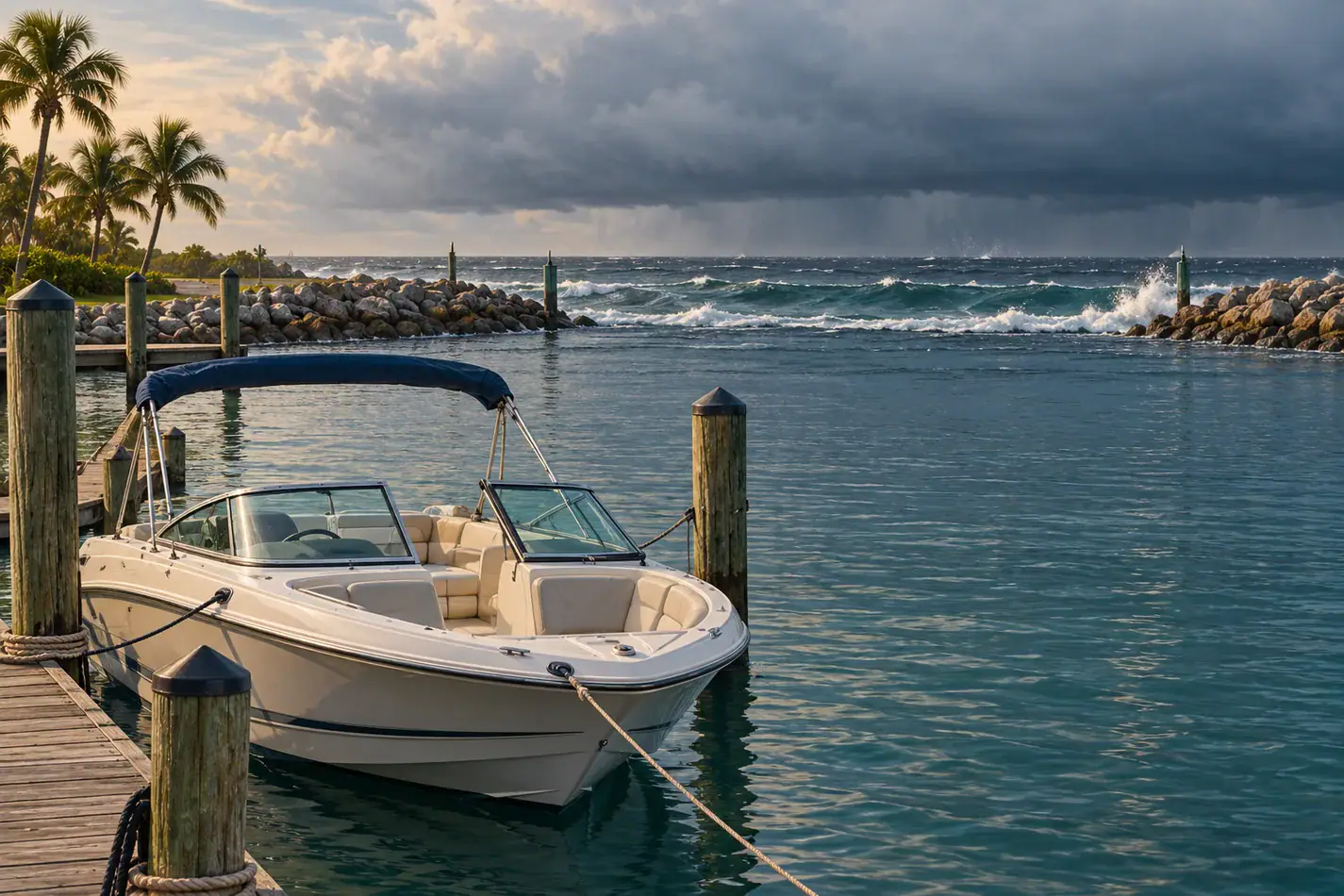
The boat is ready, the cooler is packed, and then you see Small Craft Advisory in the forecast. Does that mean your boat is too small to go out?
Not by itself. The National Weather Service does not draw one neat line between a small boat and a big boat. Boat type, condition, and the operator’s experience matter, and advisory criteria vary by location. An advisory means conditions may be hazardous for small craft. It is a reason to reconsider the trip, not a challenge to prove your boat can handle it. NWS marine weather FAQ
For a casual family outing, my recommendation is simple: if an advisory affects the waters you plan to use, postponing is a sensible choice. The boat ride is supposed to be the fun part.
Read the advisory, not just the little weather icon
A weather app showing sunshine does not tell you much about the ride across an exposed bay.
Open the actual marine advisory and check:
- Which waters are included.
- When it starts and ends.
- What it says about wind, gusts, and seas.
- Whether your route passes through the affected area.
- What conditions are expected when you come back.
That last one deserves attention. A comfortable morning departure does not settle the question of an afternoon return.
Also, there is no single nationwide wind number you can use as the definition of a Small Craft Advisory. Current NWS guidance allows for locally defined criteria involving wind and hazardous seas, including wave period, steepness, and swell direction. Dangerous bar conditions can involve swell meeting current and shallow water. NWS coastal marine message guidance
So if somebody says, “They only issue those when the wind reaches this number,” ask where. Then read the advisory for your waters.
Two-foot seas do not mean every wave is two feet
Marine forecasts commonly describe significant wave height, which is the average height of the highest third of waves. It is not the tallest wave you might meet. Individual waves can be considerably higher. NWS explanation of significant wave height
That matters when you picture the trip. Reading a forecast height as a firm ceiling can leave you expecting a much easier ride than the water delivers.
Wave height is only part of the story, too. Look at period, the time between waves, and their direction. Short-period waves can produce a rough, steep chop. But longer-period swell is not automatically harmless: it can create hazards as it reaches shallow water near shore. NWS wave-detail forecasts
There is no useful shortcut that turns one wave-height number into “safe for every boat this long.”
The inlet may be the hardest part of the day
Imagine the wind has eased, but there is still swell outside. Your return takes you through an inlet while a strong current runs against the waves. NWS guidance specifically recognizes the interaction of swell, current, and shallow water at bars. NWS hazardous-seas guidance
That is a different question from whether the wind looks manageable at the dock. NWS boating guidance warns that wind opposing a strong tidal current can create steep, dangerous waves. NWS safe-boating guidance
Do not reduce this to “outgoing tide bad, incoming tide good.” The direction and strength of the current, waves, local bottom, and particular inlet all matter.
And a tide-height chart is not the same as a current prediction. NOAA explains that high or low water does not generally occur at the same time as slack current. Use the relevant local current information rather than assuming the water stops moving at high tide. NOAA Tides and Currents FAQ
If you do not know how to assess that inlet, a marginal-weather day is a poor time to learn by trial and error.
No advisory does not guarantee a good boating day
You can have unsuitable conditions without a Small Craft Advisory. NWS also uses Marine Weather Statements to describe non-severe but potentially hazardous conditions. NWS marine weather statement guidance
Your own limit can be more conservative than the official alert threshold. A forecast that an experienced crew accepts may be the wrong choice for an unfamiliar boat, a nervous passenger, or a family expecting a relaxed afternoon.
Think about the actual trip: who is aboard, the boat’s condition and loading, the distance from useful shelter, and whether you have a realistic alternative if conditions worsen. Those are planning questions, not a mathematical guarantee.
Thunderstorms need their own decision
A Small Craft Advisory is not the only marine alert worth reading. A Special Marine Warning covers certain short-lived hazards, including strong thunderstorm winds and waterspouts. It can appear alongside an advisory; it is not simply the next step on one tidy alert ladder. NWS Special Marine Warning guidance
More importantly, do not wait for that warning before taking lightning seriously. All thunderstorms produce lightning, and NWS does not issue a separate lightning warning. Plan to avoid being caught on the water and reach suitable shelter before the storm arrives. NWS boating thunderstorm safety
“It's only a chance of storms” is not much of a plan if the whole return route is exposed.
Try the return trip on paper first
Here is a simple planning example, not a forecast: you want to leave at 9 a.m. and return at 3 p.m., but an advisory begins at noon. The morning dock conditions do not answer whether that afternoon crossing makes sense.
Before loading up, jot down your exposed crossing, expected return time, a usable place to seek shelter, and what would make you cancel or return earlier. If the plan depends on the weather improving exactly on schedule, give yourself a better option.
A quick check before leaving the dock
Here is a practical way to organize the decision. This is a planning checklist, not an official pass-or-fail formula:
- Read the marine forecast and alerts for the whole route. Include the return time, with room for delays.
- Look beyond wind speed. Review gusts, waves, period, direction, visibility, and thunderstorms.
- Check recent observations. Compare nearby buoy or station reports with the forecast. A sheltered dock does not show you the exposed crossing. NWS recommends checking forecasts and observations before departure. NWS before-you-go checklist
- Identify the difficult section. That could be an inlet, an open crossing, or the trip back after the wind changes.
- Decide what would make you cancel. Make that decision before everybody has settled into their seats.
- Have a way to keep receiving weather information. Do not assume your phone will have a dependable connection everywhere you go.
If you need a refresher on marine-radio basics, start with our VHF marine radio guide.
The bottom line
A Small Craft Advisory is useful information, but it cannot assess your boat and crew for you. Read the actual advisory, think about the entire route, and leave yourself permission to change the plan.
There will be another boating day. Leave the boat tied up if the plan no longer makes sense. You can still put that cooler to good use on shore.