

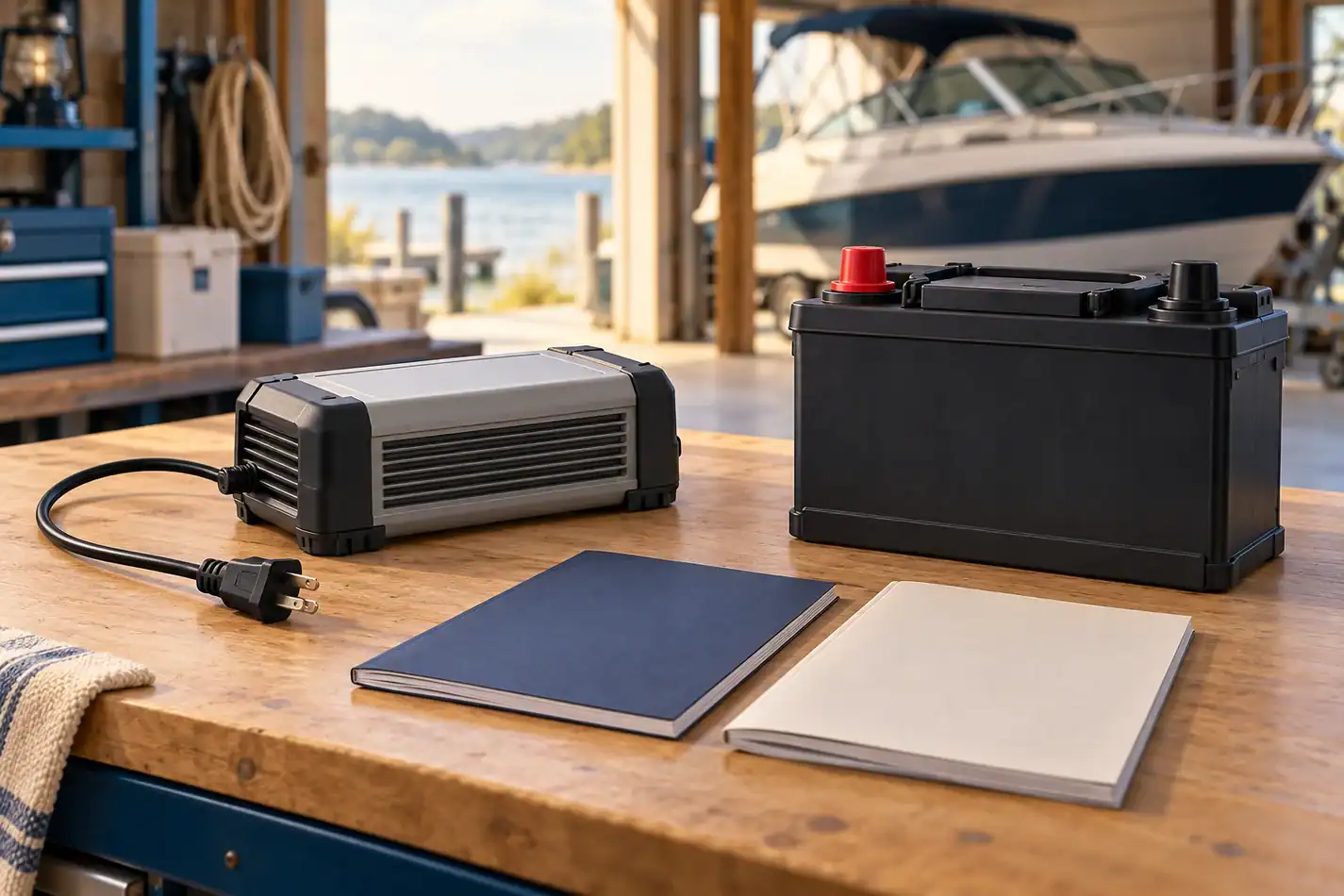
Sometimes, yes. But “it's a smart charger” is not enough information to make that decision.
You need to know what the exact charger allows, what your batteries require, and whether the installation is suitable for that use. Keeping a battery ready between trips is also different from leaving a boat in storage for months.
And there is one distinction worth making right away: a charger that can maintain a full battery does not automatically come with permission to leave it unattended.
Start with the model number, not the word “smart”
Some chargers are specifically designed for extended battery maintenance. Minn Kota, for example, describes onboard chargers that enter a float stage and then a long-term storage mode, monitoring battery voltage and resuming charging when necessary. Minn Kota charger selection guide
That explains why the answer is not always “unplug it the second the battery is full.”
But it does not prove that every charger works that way. Before leaving yours connected, find the manual for the exact model and answer three questions:
- Is extended maintenance an intended use?
- Is the selected mode correct for the battery?
- What does the manual say about supervision and the charging location?
If you cannot answer those yet, check the manual before leaving it connected. A few minutes with the model number beats guessing.
Maintenance mode and unattended use are different
Here is a detail that is easy to miss while looking at features: the official NOCO GENPRO Series user guide warns against leaving the product unattended while in use. The same guide describes charging and maintenance functionality. NOCO GENPRO user guide
Those statements are not interchangeable. Automatic charge control addresses what the charger does to the battery. A supervision warning addresses how you are allowed to use the product.
Do not translate “maintains the battery” into “I can leave town while it runs.” Follow the actual warning. If the manufacturer’s instructions seem unclear or inconsistent, get clarification for that model before relying on unattended operation.
A green light is useful. It is not permission to skip the rest of the manual.
The battery gets a vote, too
“Marine battery” is not a complete description. Flooded lead-acid, AGM, and lithium batteries can have different charging and storage requirements. Match the battery’s chemistry and voltage to an approved charging setup; do not choose a mode by guessing from the case color.
For flooded lead-acid batteries, Trojan recommends fully charging before storage, monitoring their condition during storage, and maintaining electrolyte levels according to its instructions. That does not mean adding water to a sealed battery. Trojan battery maintenance guidance
Lithium needs the same model-specific approach. For example, Battle Born’s BB10012/BB10012H manual recommends fully charging and disconnecting the battery for storage. That is a particular manufacturer’s instruction, not a universal storage rule for all lithium batteries. Battle Born standard-battery manual, storage section
The lesson is not that one chemistry is “set and forget.” Read both manuals. A charger’s long-term-maintenance feature cannot overrule the battery maker’s storage directions.
A good charger cannot fix a bad AC connection
The charging setup includes more than the box mounted in the boat.
Minn Kota’s Precision PCL installation instructions address GFCI-protected AC power, cord requirements, ventilation, and keeping connections away from water. Those details are part of using the charger, not optional extras after installation. Minn Kota Precision PCL manual
Before deciding to leave a setup connected, consider the whole path from the outlet to the battery. Damaged cords, unsuitable connections, and an installation you do not understand are reasons to stop and have the setup checked, not reasons to buy a “smarter” charger.
Do not improvise shore-power adapters or treat this article as wiring instructions. If you are unsure about the boat’s AC system, have a qualified marine electrician inspect it.
Also, waterproof does not mean every part of the charging setup can sit in water. Minn Kota specifically distinguishes its onboard and portable products and warns against operating its onboard chargers while immersed. Follow the installation and environmental limits for yours. Minn Kota charger guidance
Between trips is different from winter storage
Think about what you are actually trying to accomplish.
Using the boat regularly: You want an appropriate charging routine after use and a battery ready for the next trip. Extended maintenance may fit that routine if both manuals and the installation support it, including any supervision requirements.
Putting the boat away for months: You need the battery manufacturer’s storage procedure, an inspection plan, and a clear understanding of what still draws power. Continuous charging is not automatically the correct storage procedure.
Keeping the boat in the water: Do not blindly disconnect everything because a battery-storage article says “remove the loads.” Establish which circuits need to remain available, including any automatic bilge-pump arrangement, and get qualified help with isolation if you are unsure. A dry-storage recommendation is not a wiring plan for a boat left afloat.
Our Florida dry-stack versus trailer-storage guide can help with the bigger storage decision. Either way, ask the facility about its electrical-use rules instead of assuming an available outlet is permission to use it.
Make the decision before you plug it in
Write down these details once, and keep them with the boat’s records:
- Charger make, model, and manual.
- Battery make, model, chemistry, and voltage for each bank.
- The approved charging mode.
- Whether extended maintenance is permitted.
- Any supervision restrictions.
- The battery’s long-term storage procedure.
- Who will inspect the setup, and how it can be safely disconnected if necessary.
Have the equipment details ready when you ask the manufacturer: “Can this exact charger maintain this battery in the selected mode between trips, and what supervision does your manual require?” Add whether the boat will be ashore or afloat and how long you plan to leave it. That gives support a real setup to assess instead of a vague question about a “marine battery.”
If something is damaged, behaving abnormally, or producing an error you do not understand, do not leave it charging and hope the automatic features sort it out. Follow the manufacturer’s safety instructions and have the fault assessed. Do not bypass protections to keep the charging cycle going.
The bottom line
You may be able to leave an appropriate boat battery charger connected for maintenance. You should not assume that means every charger, every battery, every location, or unattended use.
Check the exact equipment and its instructions. Once that part is settled, you can spend less time wondering about the battery and more time planning the next trip.