

The number of people a boat can safely hold is printed on its U.S. Coast Guard capacity plate, which must be posted where the operator can see it. Federal law requires that plate on most monohull boats under 20 feet. It lists a maximum number of persons and a maximum weight, and the weight is the real limit. If your boat has no plate, the Coast Guard’s rule of thumb is length × width ÷ 15. For boats 20 feet and over, use the builder’s rated capacity.
Some links on this page are paid affiliate links. If you purchase through them, BoatLife365 may earn a commission. As an Amazon Associate I earn from qualifying purchases.
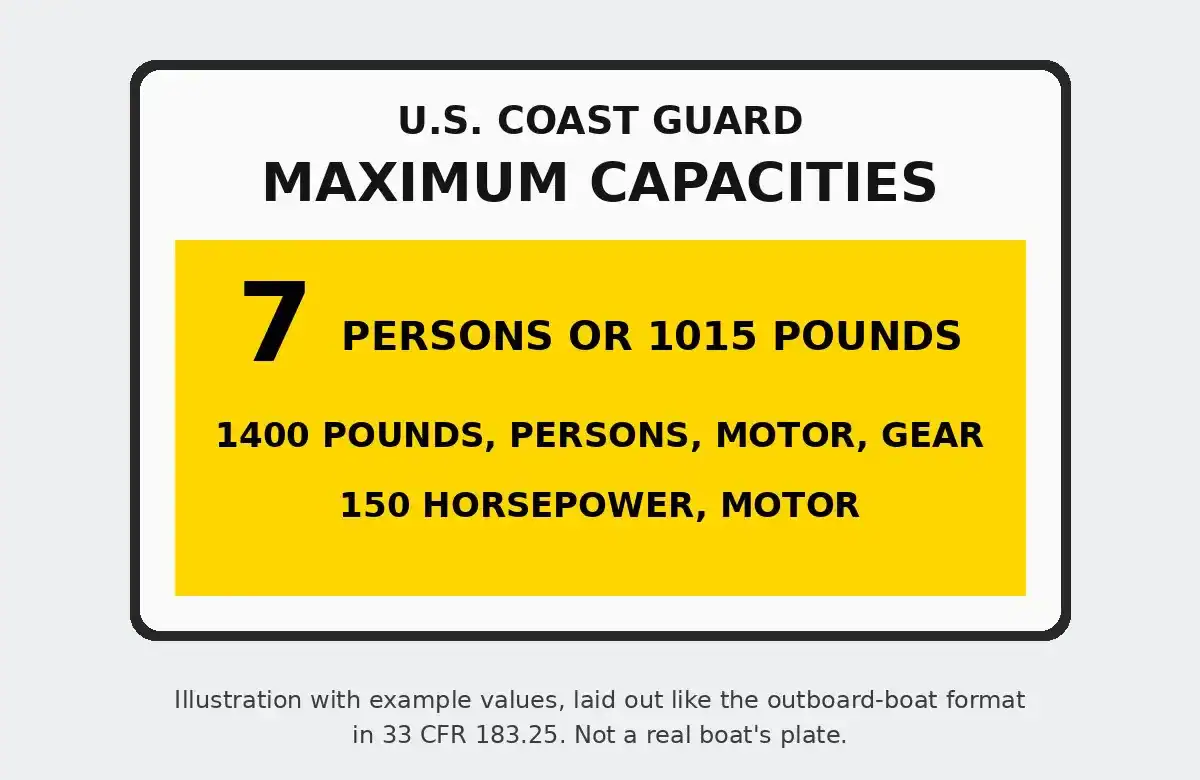
Below we explain how to read the plate, how the Coast Guard formula turns pounds into a head count, why two 20-foot boats from the same builder can carry different numbers of people, and what happens if you load past the limit.
Which boats must have a capacity plate?
Under 33 CFR 183, Subpart B, the capacity marking rule applies to monohull boats less than 20 feet long, except sailboats, canoes, kayaks and inflatable boats. Each of those boats must be marked with:
- The maximum persons capacity, in whole persons and in pounds
- The maximum weight capacity in pounds
- The maximum horsepower, or the statement that the boat isn’t rated for a motor
The plate must be permanently displayed where the operator can clearly see it when getting underway. It must also resist removal or alteration without leaving obvious signs.
What about boats 20 feet and over, and pontoons?
The federal plate rule stops at 20 feet and covers only monohulls, so a pontoon boat isn’t covered by it. Capacity labels are still common on bigger boats and pontoons through industry certification. The National Marine Manufacturers Association (NMMA) supplies capacity tags to its certified builders for:
- Outboard and inboard boats from 20 to 26 feet
- Pontoon boats over 20 feet
- Yacht plates for boats 26 feet and over
NMMA’s certification program lists ABYC standard H-5, “Capacity,” among the standards it certifies to. If your boat is 20 feet or longer and has no plate, look in the owner’s manual or on the builder’s spec page for its rated capacity.
How to read a capacity plate
The illustration above follows the outboard-boat layout set out in 33 CFR 183.25. A real plate has three lines inside a yellow box:
| Line on the plate | What it means |
|---|---|
| “X PERSONS OR XXX POUNDS” | The maximum people aboard, as a head count and as total body weight. Whichever you reach first is your limit. |
| “XXX POUNDS, PERSONS, MOTOR, GEAR” | The total load the boat can carry. On outboard boats this includes the motor. Inboard and sterndrive plates read “PERSONS, GEAR” instead. |
| “XXX HORSEPOWER, MOTOR” | The largest outboard the boat is rated for. Some plates list separate ratings with and without remote steering. |
The head count assumes lighter people than you might think
The persons number on the plate isn’t arbitrary. Under 33 CFR 183.41, the maximum head count on an outboard boat can’t exceed the persons capacity in pounds plus 32, divided by 141, rounded to the nearest whole number. Inboard boats follow the same formula under 183.39.
Take our example plate. With 1,015 pounds of persons capacity, (1,015 + 32) ÷ 141 = 7.4, which rounds down to 7 people. Now suppose your crew averages 190 pounds (your own number goes here): 7 × 190 = 1,330 pounds, well over 1,015. In that case five adults (950 lb) is the real limit, not seven. Always load by the pounds line.
Where the weight number comes from
For outboard boats, 33 CFR 183.35 caps the maximum weight capacity at one-fifth of the difference between the boat’s maximum displacement and its own weight. In plain terms, the builder works out how much water the boat can displace, level, before water comes aboard, subtracts the boat’s weight, and is allowed to rate only a fraction of what’s left. The persons capacity is then that weight capacity minus the motor, controls, battery and any portable fuel tank (183.41). That is why the persons-in-pounds figure is always smaller than the total weight figure.
No plate? The Coast Guard rule of thumb
The Coast Guard’s A Boater’s Guide to the Federal Requirements for Recreational Boats says that if your boat lacks a capacity plate, you should:
- Check with the manufacturer, if it’s still in business.
- If not, look online for a sister vessel.
- Hire a naval architect or marine engineer.
- As a last resort, use this rule of thumb: maximum number of persons = boat length × boat width ÷ 15.
The guide notes that the rule is based on a 150-pound person and “does not account for displacement/volume.” For example, a boat 18 feet long and 7 feet wide gives 18 × 7 ÷ 15 = 8.4, so about 8 people of 150 pounds. Treat that as a ceiling, not a target. The guide’s own warning is plain: “Do not exceed the load specified on your boat’s capacity plate.”
Deck boat vs. bowrider: real 20-foot capacity numbers
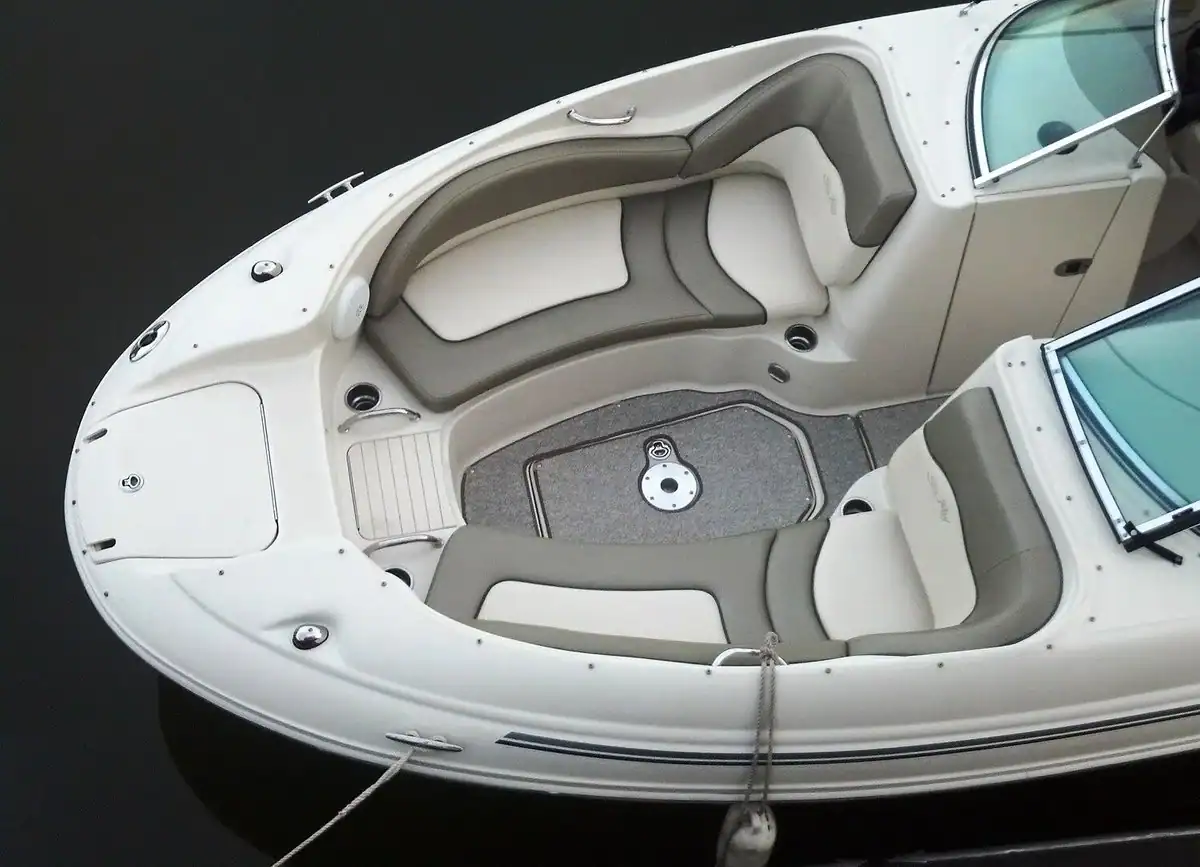
A common question is whether a 20-foot deck boat holds more people than a 20-foot bowrider. Bayliner builds both styles, so its current spec pages make a fair comparison:
| Model | Type | Length | Beam | Persons | Max weight capacity | Approx. weight with standard engine |
|---|---|---|---|---|---|---|
| Bayliner D20 | Deck boat, outboard | 19′ 6″ | 8′ 1″ | 10 | 1,653 lb | 3,396 lb |
| Bayliner V20 | Bowrider, outboard | 20′ 4″ | 8′ 4″ | 10 | 1,650 lb | 3,380 lb |
| Bayliner D20i | Deck boat, inboard/sterndrive | 19′ 6″ | 8′ 1″ | 9 | 1,270 lb | 3,880 lb |
| Bayliner V20i | Bowrider, inboard/sterndrive | 20′ 4″ | 8′ 4″ | 9 | 1,485 lb | 3,985 lb |
| Bayliner D22 | Deck boat, outboard | 21′ 6″ | 8′ 6″ | 12 | 1,692 lb | 3,994 lb |
| Bayliner V22 | Bowrider, outboard | 22′ 5″ | 8′ 4″ | 12 | 1,800 lb | 3,731 lb |
Three takeaways from these figures:
- Same-size deck boats and bowriders can have the same rated head count. The D20 and V20 are both rated for 10 people, and the D22 and V22 for 12. A deck boat’s wider bow can give more comfortable seating, but it doesn’t automatically raise the legal number.
- Engine type matters. The inboard D20i is rated for one fewer person and about 380 lb less capacity than the outboard D20, and it weighs about 480 lb more with its standard engine.
- Weight capacity is the tiebreaker. The V22 is rated for the same 12 people as the D22 but carries 108 lb more.
For the bigger picture on layout and seating, see our comparison of bowrider vs. deck boat and our picks for the best bowrider under 20 feet. Weighing a pontoon too? Read bowrider vs. pontoon.
Is it illegal to overload a boat?
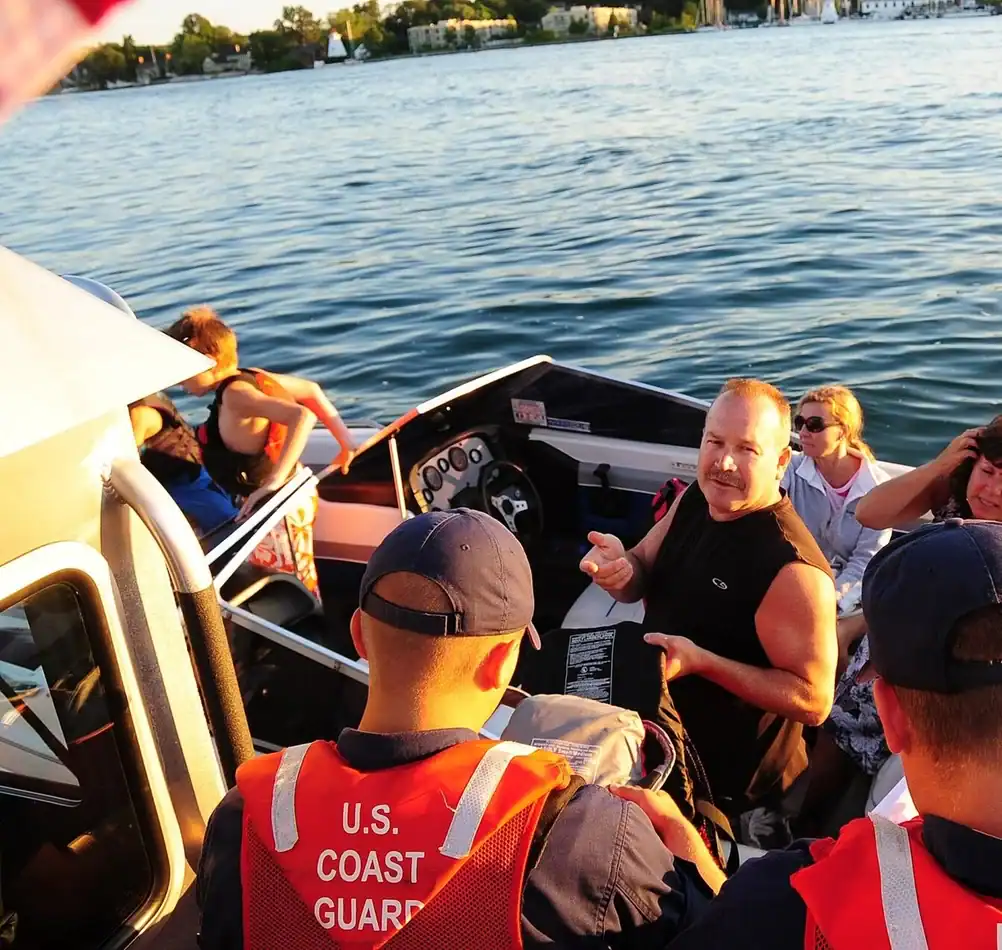
Yes, it can stop your trip. The Coast Guard’s Boater’s Guide lists “an overloaded vessel” among the especially hazardous conditions for which a boarding officer may terminate a voyage and order the operator back to port (46 U.S.C. 4308, 33 CFR 177.05). An operator who refuses can be cited, and the guide says violators may be fined up to $1,000, imprisoned for up to one year, or both. State laws can add their own rules, so check your state’s boating agency too.
Overloading is also a documented cause of accidents. In the Coast Guard’s 2025 Recreational Boating Statistics, overloading was the primary contributing factor in 27 incidents, with 8 deaths and 19 injuries. The wider “loading of passengers or gear” category accounted for 116 incidents and 27 deaths. That category includes people riding on the gunwale, bow or transom (34 incidents, 9 deaths).
How to load your boat safely
The Coast Guard’s safe-loading advice is short:
- Distribute the load evenly, front to back and side to side.
- Keep the load low in the boat.
- Keep passengers seated and discourage standing.
- Secure gear so it can’t shift.
Before you add a guest, also check life jackets. Federal rules require one wearable life jacket for each person on board, of the right size for that person, plus one throwable device on boats 16 feet and longer (except canoes and kayaks). If more people are coming than you have life jackets for, a set like the Kent four-pack of adult universal Type II life jackets with a clear storage bag covers four adults (the listing says they fit adults 90 lb and over with a 30–52 inch chest). Kids need properly sized jackets; see our guide on how a child’s life jacket should fit.
A quick pre-trip capacity check
- Read the persons-in-pounds line on the plate.
- Add up everyone’s approximate weight.
- Add coolers, fuel cans, dive or fishing gear and anything else heavy, and compare against the total weight line.
- Count wearable life jackets that fit each person.
- Check conditions and leave margin. The Coast Guard’s definition of overloading includes “dangerously reduced freeboard”, and rough water eats into freeboard fast.
Frequently asked questions
How many people can a 20-foot boat hold?
It depends on the boat, so read its plate or spec sheet. Among current Bayliner 20-foot models, the outboard D20 deck boat and V20 bowrider are rated for 10 people, and their inboard versions for 9.
Do deck boats hold more people than bowriders?
Not necessarily. Bayliner’s deck boats and bowriders of the same size carry the same rated number of people (10 for the 20-foot pair, 12 for the 22-foot pair). Check the specific models you’re comparing.
How much weight per person does the capacity plate assume?
The federal formula converts pounds to people by adding 32 and dividing by 141. The no-plate rule of thumb assumes 150 pounds per person. If your passengers are heavier, use the pounds figure, not the head count.
Does the weight capacity include the motor?
On outboard boats, yes. The line reads “persons, motor, gear.” On inboard and sterndrive boats it reads “persons, gear” because the engine is part of the boat.
Are pontoon boats required to have a Coast Guard capacity plate?
The federal rule covers monohulls under 20 feet, so pontoons aren’t covered by it. NMMA-certified pontoon builders apply capacity tags, so most new pontoons still carry one.
Safety note
A capacity plate gives maximums for calm conditions, not a target. Rough water, a passenger moving forward or a heavy cooler on one side all reduce your margin. When in doubt, take fewer people, keep everyone seated, and make sure each person has a properly fitting life jacket. The Coast Guard’s guide says you and your passengers should always wear your life jackets when the boat is underway.
Sources
- 33 CFR Part 183, Subpart B (display of capacity information, 183.21–183.27): ecfr.gov 33 CFR 183 Subpart B
- 33 CFR Part 183, Subpart C (safe loading, 183.31–183.43): ecfr.gov 33 CFR 183 Subpart C
- U.S. Coast Guard, A Boater’s Guide to the Federal Requirements for Recreational Boats (safe loading, capacity rule of thumb, termination of use, PFDs): uscgboating.org (PDF)
- U.S. Coast Guard, 2025 Recreational Boating Statistics (Table 5): uscgboating.org (PDF)
- NMMA, Capacity Tags & Yacht Plates: nmma.org
- NMMA, Boat and Yacht Certification Program Standards Basis: nmma.org
- Bayliner D20 specifications: bayliner.com; D20i: bayliner.com; D22: bayliner.com
- Bayliner V20 specifications: bayliner.com; V20i: bayliner.com; V22: bayliner.com