

Based on current Boston Whaler and Grady-White spec sheets, center console boats from 17 to 21 feet weigh about 1,700 to 3,360 pounds as a bare hull, and Boston Whaler’s 17- to 21-foot Montauks weigh about 2,250 to 3,650 pounds once the engine, fuel and water are added. Offshore models in the 28- to 30-foot range start above 6,000 pounds dry, and Grady-White’s Canyon 306 tested at 10,286 pounds with people, fuel and gear aboard. The number that matters for towing is higher still, because the trailer, gear and everything in the tanks ride along too.
Some links on this page are paid affiliate links. If you purchase through them, BoatLife365 may earn a commission. As an Amazon Associate I earn from qualifying purchases.
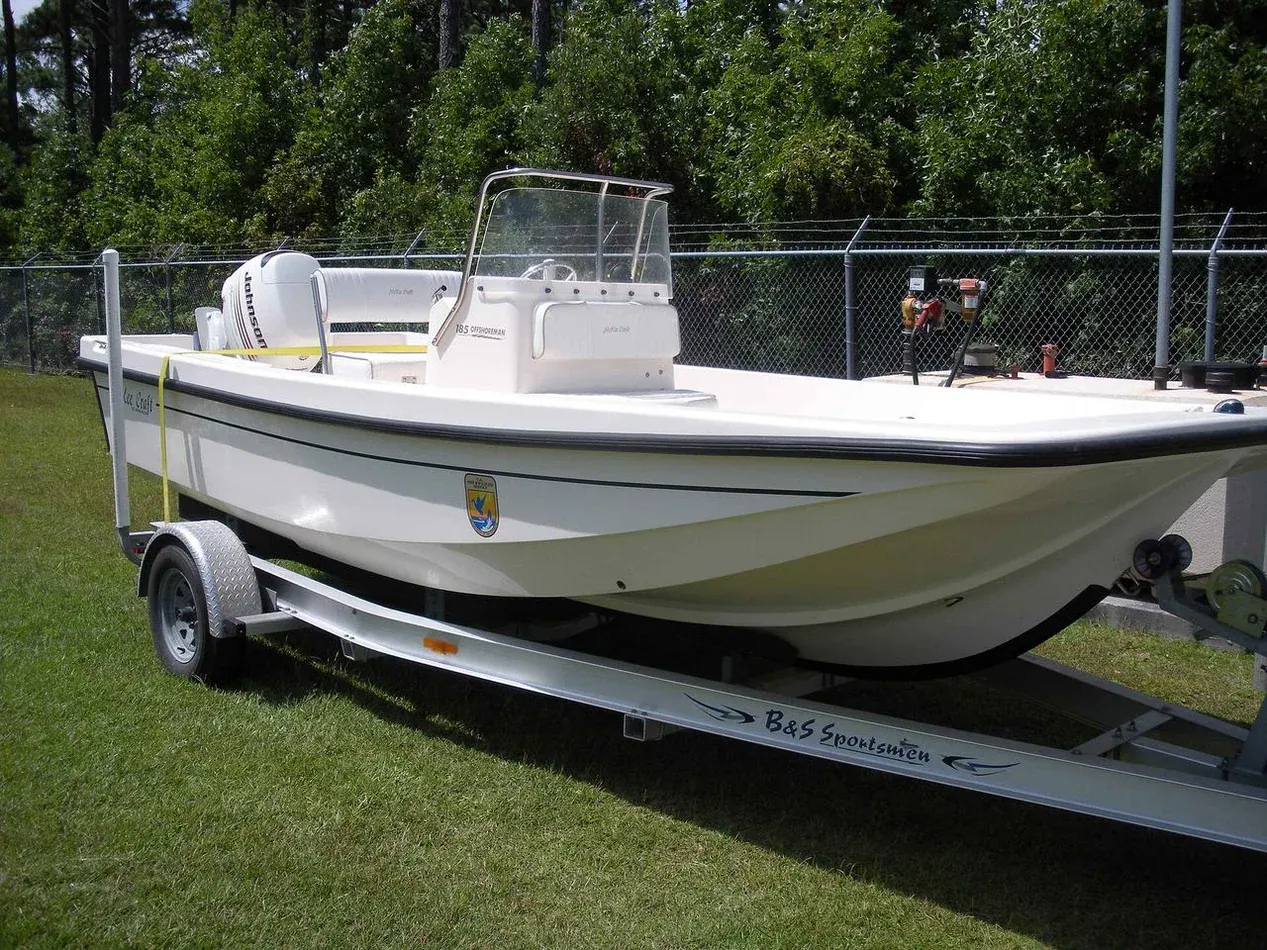
Below you will find real published weights for six center consoles, an explanation of what each kind of “weight” on a spec sheet actually includes, and a step-by-step method for working out what your own rig weighs on the road.
Center console weights from manufacturer spec sheets
The table uses figures published by Boston Whaler and Grady-White on their own model pages. Builders do not measure weight the same way, so read the column notes before comparing one brand to another.
| Model | Length | Dry weight (no engine) | Heavier figure the builder publishes | Fuel capacity |
|---|---|---|---|---|
| Boston Whaler 170 Montauk | 17′ 4″ LOA | 1,700 lb | 2,254 lb with standard engine, fuel and water | 25 gal |
| Boston Whaler 190 Montauk | 19′ 4″ LOA | 2,000 lb | 2,769 lb with engine, fuel and water | 60 gal |
| Boston Whaler 210 Montauk | 21′ 4″ LOA | 2,650 lb | 3,650 lb with engine, fuel and water | 66.5 gal |
| Grady-White Fisherman 216 | 21′ 3″ centerline (23′ 3″ with swim platforms) | 3,360 lb without engines | 5,069 lb “as tested” with a single Yamaha 200, including persons, fuel, water, gear and accessories | 80 gal |
| Boston Whaler 280 Outrage | 28′ LOA | 6,200 lb | 8,961 lb with engines, fuel and water | 186 gal |
| Grady-White Canyon 306 | 30′ 6″ centerline | 7,220 lb without engines | 10,286 lb “as tested” with twin Yamaha 300s, including persons, fuel, water, gear and accessories | 290 gal |
Two patterns stand out. First, weight climbs much faster than length: the 210 Montauk is four feet longer than the 170 Montauk but weighs 950 pounds more as a bare hull. Second, the gap between “dry” and “ready to run” is large. On the 170 Montauk, Boston Whaler’s two figures differ by 554 pounds; on the 280 Outrage the gap is 2,761 pounds.
If you are still shopping, our list of 15 center console boats for family and fishing and our guide to the best center console boat under $50k are good places to pull model names, then check each builder’s current spec page for weight.
What “dry weight” really means (and what it leaves out)
Spec sheets use several different weights, and mixing them up is the most common reason a tow vehicle ends up overloaded.
Dry weight, no engine
This is the hull and its standard factory equipment with no outboard, no fuel and no water. Boston Whaler labels it “Weight (dry, no engine)” and Grady-White labels it “Weight (w/o Engines).” It is useful for comparing hulls, but nobody tows a boat in this state.
Weight with engine, fuel and water
Boston Whaler also lists a figure with the standard engine, fuel and water. It is closer to reality, but it still does not include your gear, batteries you add, ice, people’s belongings or the trailer.
“Weight as tested”
Grady-White publishes the weight of the specific boat used in its performance tests, and says that figure includes persons, fuel, water, gear, engines and accessories. Those people are not part of your towing weight, so treat this number as an on-the-water figure, not a trailer figure.
Maximum weight capacity is not the boat’s weight
Spec sheets and capacity plates also show a “maximum weight capacity,” such as 1,900 pounds on the 170 Montauk. That is how much the boat is rated to carry in people, motor and gear, not what the boat weighs. Federal rules require monohull boats under 20 feet (with some exceptions, such as sailboats, canoes, kayaks and inflatables) to carry a capacity marking that shows maximum persons, maximum weight capacity and maximum horsepower.
How much does the outboard add?
Outboards are heavy, and many hull-only figures exclude them. Yamaha lists its F150 at 509 pounds and its F200 at 516 pounds for the 20-inch mechanical models. Yamaha notes that those weights are for the shortest shaft length and are measured without motor oil, gearcase oil and propeller, so the installed engine weighs somewhat more.
Builders also cap how much engine a transom can take. Boston Whaler lists a maximum engine weight of 410 pounds for the 170 Montauk, 530 pounds for the 190 Montauk, 700 pounds for the 210 Montauk and 1,400 pounds for the twin-engine 280 Outrage. If you are repowering, check that number before choosing a heavier motor.
Fuel, water and gear: the weight people forget
The BoatUS Foundation’s trailering guidance counts gasoline at about six pounds per gallon and water at about eight pounds per gallon. That makes the fuel tank one of the biggest variables on a center console:
- A 25-gallon tank (170 Montauk) holds about 150 lb of gasoline when full.
- A 60-gallon tank (190 Montauk) holds about 360 lb.
- An 80-gallon tank (Fisherman 216) holds about 480 lb.
- A 186-gallon tank (280 Outrage) holds about 1,116 lb.
Water counts too. A livewell, raw-water washdown or freshwater tank you forgot to drain adds roughly eight pounds per gallon. Then add the items most owners keep aboard: batteries, anchor and rode, coolers, tackle, rods, safety gear and canvas. None of those appear in a dry weight.
How to calculate your real towing weight
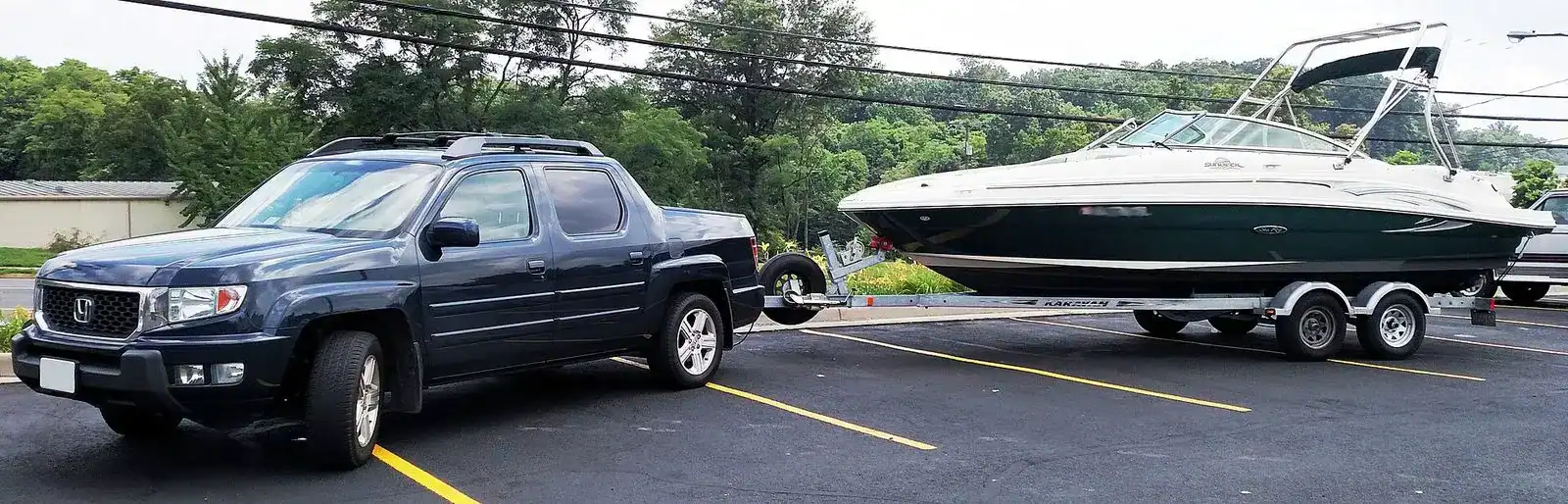
Your towing weight is the boat, engine, fluids and gear plus the trailer itself. Use this checklist to build the number, then confirm it on a scale.
- Start with the builder’s heaviest published “boat” figure that does not include people, for example Boston Whaler’s weight with engine, fuel and water. If you only have a dry, no-engine weight, add the engine weight from the engine maker.
- Add fuel at about 6 lb per gallon for the amount you actually tow with, not the tank’s capacity, unless you tow full.
- Add water at about 8 lb per gallon for anything left in tanks or wells.
- Add gear: batteries, anchors, coolers, fishing equipment, safety equipment and anything else stowed aboard.
- Add the trailer. Its weight is not on the boat’s spec sheet. Get it from the trailer manufacturer or weigh it.
- Weigh the loaded rig. A certified public scale removes the guesswork and is the only way to know your actual axle and tongue loads.
If you want a printable way to do this, our loaded boat and trailer tow worksheet walks through the same steps and keeps the ratings and the measured weights side by side.
A worked example using published numbers
Take a Boston Whaler 210 Montauk. Boston Whaler lists 3,650 lb with engine, fuel and water. Suppose you add 200 lb of gear (your number will differ). That is 3,850 lb before the trailer. Add the trailer’s own weight from its manufacturer, then compare that total with your trailer GVWR, hitch class and the tow vehicle’s rating in its owner’s manual. Run the math with your real trailer weight before you assume a vehicle can handle it.
Check the ratings: trailer, hitch and tow vehicle
Every link in the chain has its own limit, and the lowest one wins.
| Rating | What it covers | Where to find it |
|---|---|---|
| Trailer GVWR | Total weight the trailer is rated to carry, including boat, engine, fuel, water and gear | The federal certification label, which on trailers goes on the forward half of the left side |
| Trailer GAWR | Load-carrying capacity of each axle | The same certification label, listed for each axle |
| Hitch class | Class I up to 2,000 lb, Class II up to 3,500 lb, Class III up to 5,000 lb, Class IV up to 10,000 lb | Hitch label and instructions |
| Vehicle towing capacity and GCWR | What the tow vehicle can pull, and the combined weight of vehicle, trailer, boat, passengers and cargo | Vehicle owner’s manual |
| Vehicle maximum tongue load | How much downward weight the hitch and vehicle can carry | Vehicle owner’s manual |
BoatUS notes that some experts suggest keeping the boat and gear at no more than 85% of the trailer’s GVWR as a safety margin. On a single-axle trailer, GVWR and GAWR are the same; on a tandem-axle trailer, GVWR equals twice the GAWR.
Weight also decides whether your trailer needs brakes in your state. We cover that in detail in does a boat trailer need brakes. If you are thinking about towing behind a motorhome, read can you pull a boat behind an RV first, because the RV’s own limits apply.
Tongue weight: the number that controls sway
Tongue weight is the downward force the trailer coupler puts on the hitch ball. Nissan’s towing guide, for example, tells owners to keep tongue load between 10% and 15% of total trailer weight and not to exceed the vehicle’s maximum tongue load. The guide says tongue load has a significant effect on the handling and capacity of the tow vehicle, and that if it is below the recommended amount you must move some of the load forward.
For a loaded boat and trailer that weighs 4,000 lb, 10% to 15% works out to 400 to 600 lb on the ball. The only way to know where you are is to measure it. A trailer tongue-weight scale such as the Sherline LM-2000 (rated to 2,000 lb) is one way to measure it at home; pick a scale whose capacity fits the tongue weight you expect. A public scale that reads each axle is another.
Quick reference by size
These ranges come only from the six models in the table above. Other brands and option packages will land outside them, so use them as a starting point, not a substitute for your boat’s spec sheet.
- 17–19 feet: 1,700–2,000 lb dry, no engine; about 2,250–2,770 lb with engine, fuel and water (Boston Whaler 170 and 190 Montauk).
- 21 feet: 2,650–3,360 lb dry, no engine (Boston Whaler 210 Montauk, Grady-White Fisherman 216).
- 28–30 feet: 6,200–7,220 lb dry, no engines; 8,961 lb with engines, fuel and water on the 280 Outrage.
Safety note
Never rely on a brochure dry weight to decide whether a vehicle can tow a boat. Confirm every rating (trailer GVWR and GAWR, hitch class, vehicle towing capacity, GCWR and maximum tongue load) in the owner’s manuals and on the labels, weigh the loaded rig, and stay under the lowest limit. BoatUS also recommends using safety chains crossed under the coupler and using a shackle or pin instead of standard S-hooks, which can jiggle loose. If your vehicle maker publishes front-wheel-drive or other towing restrictions, those apply as well; our article on pulling a boat with front-wheel drive covers that case.
FAQ
How much does a 20-foot center console boat weigh?
Among the models above, the 21-foot boats weigh 2,650 lb (Boston Whaler 210 Montauk) to 3,360 lb (Grady-White Fisherman 216) without engines. With engine, fuel and water, Boston Whaler lists the 210 Montauk at 3,650 lb. The trailer and your gear come on top of that.
Does dry weight include the engine?
It depends on the builder. Boston Whaler and Grady-White both publish a weight without the engine. Always read the label on the spec line, because other builders sometimes quote weight with an engine.
How much does a full fuel tank add?
Using the BoatUS figure of about six pounds per gallon, multiply your gallons by six. A 60-gallon tank adds about 360 lb when full.
Is the capacity plate weight the same as the boat’s weight?
No. The capacity plate’s maximum weight is how much the boat can safely carry in people, motor and gear. It says nothing about what the boat weighs on a trailer.
What is the most accurate way to know my boat’s weight?
Weigh the loaded boat and trailer, hitched and unhitched, on a certified public scale with the fuel, water and gear you normally tow with. That gives you total weight and lets you work out tongue weight.
Sources
- Boston Whaler, 170 Montauk specifications: bostonwhaler.com/us/en/boats/montauk/170-montauk
- Boston Whaler, 190 Montauk specifications: bostonwhaler.com/us/en/boats/montauk/190-montauk
- Boston Whaler, 210 Montauk specifications: bostonwhaler.com/us/en/boats/montauk/210-montauk
- Boston Whaler, 280 Outrage specifications: bostonwhaler.com/us/en/boats/outrage/280-outrage
- Grady-White, Fisherman 216 specifications: gradywhite.com/models/fisherman-216/
- Grady-White, Canyon 306 specifications: gradywhite.com/models/canyon-306/
- Yamaha Outboards, In-Line Four F150/F200 specifications: yamahaoutboards.com/outboards/350-150-hp/in-line-4
- BoatUS Foundation, Transportation & Trailering: boatus.org/study-guide/trip-planning-preparation/boat-transportation-trailering/
- Nissan, 2025 Towing Guide (tongue load guidance): nissanusa.com 2025 Towing Guide (PDF)
- 49 CFR 567.4 (vehicle and trailer certification labels, GVWR and GAWR): ecfr.gov 49 CFR 567.4
- 33 CFR Part 183, Subpart B (capacity marking): ecfr.gov 33 CFR 183 Subpart B