

For a day on the boat, start with the gear federal law requires: a U.S. Coast Guard-approved wearable life jacket for every person aboard, a throwable flotation device if the boat is 16 feet or longer, a fire extinguisher if your boat type requires one, a way to make a sound signal, visual distress signals on coastal waters, and your registration. Then add what keeps the day safe and comfortable: drinking water, sun protection, a cooler with plenty of ice, a charged phone and radio, and a float plan left with someone on shore.
Some links on this page are paid affiliate links. If you purchase through them, BoatLife365 may earn a commission. As an Amazon Associate I earn from qualifying purchases.
Below is the checklist broken into what is legally required, what the Coast Guard recommends, and what makes a long day on the water easier. A printable version is at the end.
1. Required safety equipment (federal rules)
These are the federal minimums for recreational boats, based on Coast Guard regulations and the Coast Guard’s Boater’s Guide to the Federal Requirements for Recreational Boats. Your state may add more, so also check your state boating agency.
| Item | Who needs it | Key detail |
|---|---|---|
| Wearable life jacket (PFD) | Every recreational vessel, one per person | Must be Coast Guard-approved, in good condition, the right size for the wearer and readily accessible |
| Throwable PFD | Boats 16 feet and longer (canoes and kayaks exempt) | Must be immediately available, such as on the main deck within arm’s reach |
| Fire extinguisher | Motorboats, with an exception for some outboard boats under 26 feet whose construction cannot trap fumes | Boats under 26 feet need at least one 5-B portable extinguisher unless a fixed system protects the machinery space; inspect it before each trip |
| Sound-producing device | All vessels; boats 12 meters (about 39 feet) and longer need a whistle | Boats under 12 meters may use any means of making an efficient sound signal |
| Visual distress signals | Boats 16 feet and longer on coastal waters, the Great Lakes and connected waters; smaller boats need night signals between sunset and sunrise | Pyrotechnic signals expire 42 months after manufacture; expired ones do not count |
| Navigation lights | All recreational vessels operating between sunset and sunrise or in restricted visibility | Test them before you leave if there is any chance you will be out late |
| Engine cut-off switch link | Operators of boats under 26 feet that have a cut-off switch installed | Must be attached when the boat is on plane or above displacement speed |
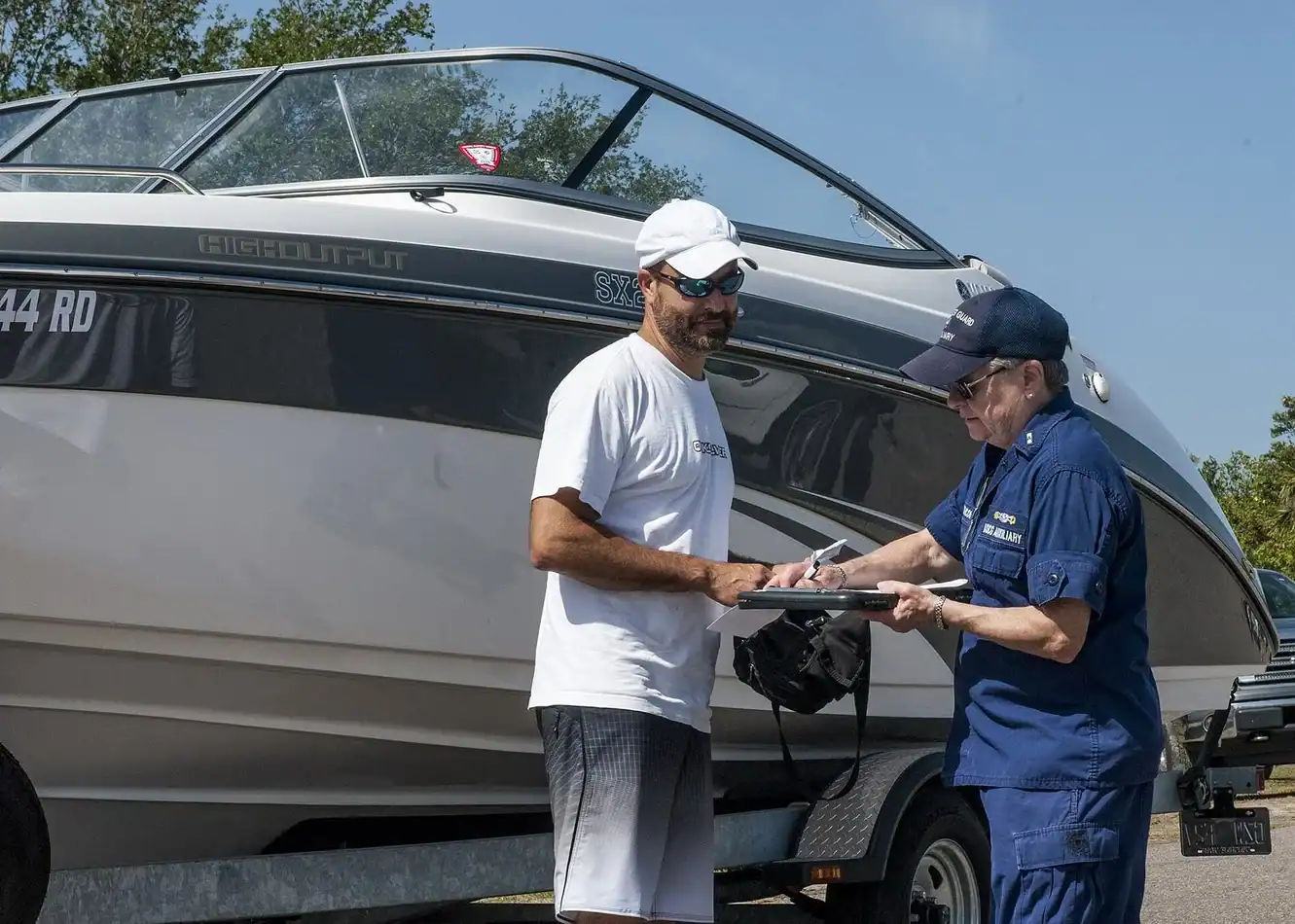
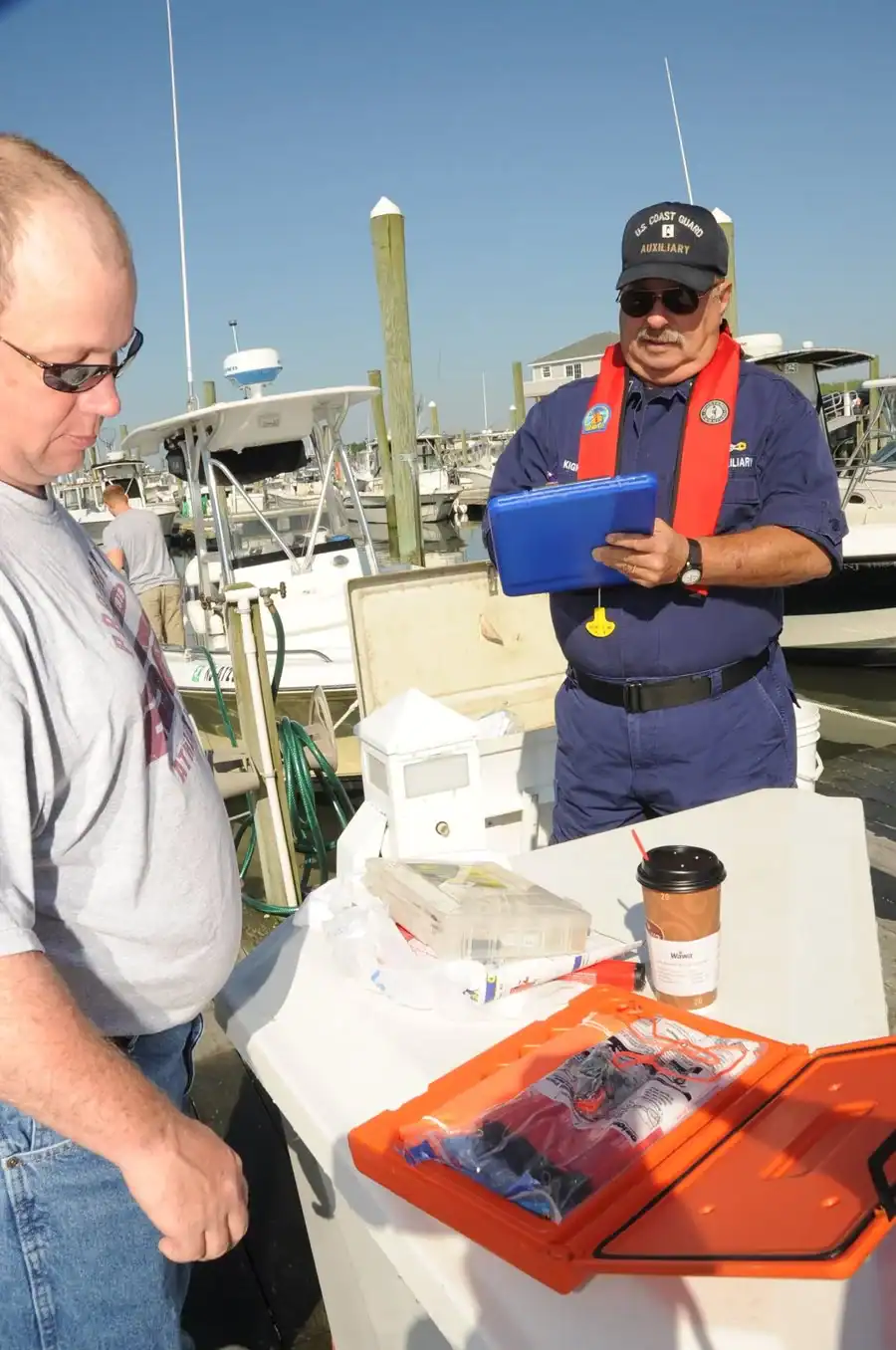
If you are unsure which extinguisher your boat needs, our guide on what type of fire extinguisher you need on a boat goes deeper. A quick way to confirm everything is a free Vessel Safety Check offered as a free public service by the Coast Guard Auxiliary and America’s Boating Club (U.S. Power Squadrons). The Coast Guard’s guide describes it as one way to ensure compliance, and boats that pass get a VSC decal.
Life jackets for kids
Under federal rules, children under 13 must wear a Coast Guard-approved life jacket while the boat is underway unless they are below deck or in an enclosed cabin. If your state has its own child life jacket law, the state rule applies instead. Fit matters as much as the label; see how to buy a life jacket that actually fits your child.
The throwable: easy to forget, easy to fix
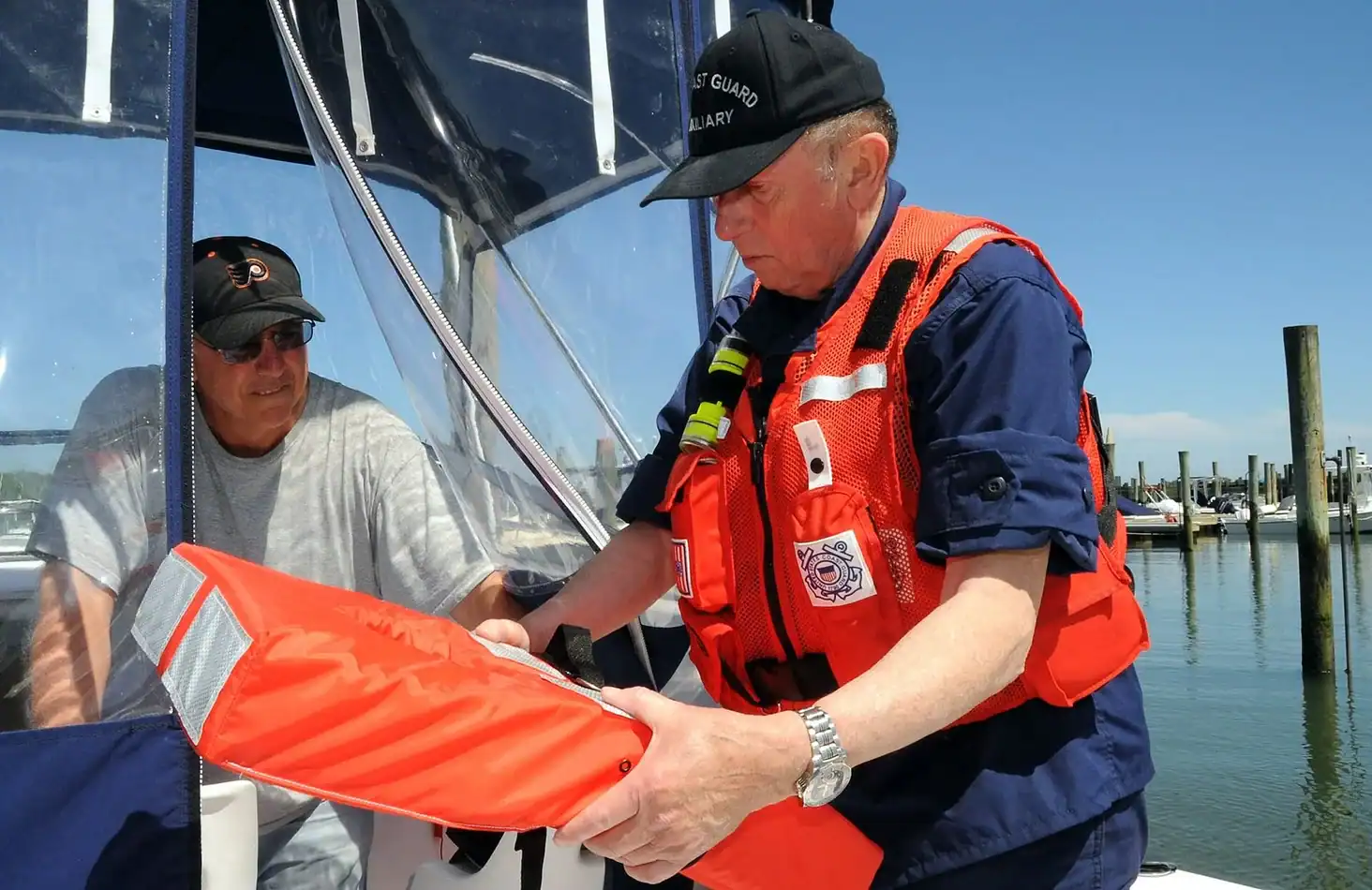
If your boat is 16 feet or longer, the throwable is required in addition to the wearable life jackets. A cushion-style throwable such as the Stearns Type IV throwable flotation cushion is a common choice. Before you buy any throwable, check that the label shows Coast Guard approval, and keep it where you can grab it instantly, not under gear.
A whistle for every life jacket
On small boats, a whistle is the simplest way to meet the sound-signal rule, and the Coast Guard’s guide also calls a whistle and an emergency light good ideas to carry with your wearable PFD, even though they are not required. A basic option is the Shoreline Marine emergency survival whistle. Clip one to each life jacket so it goes into the water with the person who needs it.
2. Paperwork to have aboard
- Certificate of Number (registration). The Coast Guard’s guide says the owner or operator must carry the valid Certificate of Number whenever the vessel is in use, and the number must be displayed on the boat.
- Boater education card, if your state requires one. Requirements vary by state and sometimes by age. Check your state boating agency before your first trip.
- Trailer and tow vehicle paperwork if you are trailering to the ramp.
3. Gear the Coast Guard recommends
- A way to call for help. The Coast Guard recommends always carrying a means of sending distress alerts and communicating with other boats, and says a VHF marine radio is the most common. It does not advocate cell phones as a substitute, though they can be an added measure of safety. Channel 16 is the calling and distress channel. New to radios? Read how to use a VHF marine radio.
- Anchor and enough line. The Coast Guard’s general rule is five to seven times as much line as the water depth plus the distance from the water to your bow cleat. In 8 feet of water with a bow 2 feet above the surface, that is 50 to 70 feet of line. Never anchor from the stern; the Coast Guard warns this could swamp the boat.
- Extra equipment offshore. If you go offshore, the Coast Guard suggests going beyond the federal minimums with appropriate communications gear, a life raft, an EPIRB, a reliable way to determine your position and, in cold water, immersion suits.
- A bailer or bucket. The Coast Guard notes a bucket can serve as a sea anchor in an emergency to keep the bow into the waves if the engine fails.
4. Sun, heat and water
Open boats often have little shade. The FDA’s sun safety advice is the right baseline for a day on the water:
- Use a broad-spectrum sunscreen with SPF 15 or higher, applied 15 minutes before sun exposure.
- Use enough to cover your whole body; the FDA says an average adult or child needs at least one ounce, about a shot glass full.
- Reapply at least every two hours, and more often when swimming or sweating. No sunscreen is waterproof; “water resistant” labels must say whether protection lasts 40 or 80 minutes.
- Do not forget ears, nose, lips, back of the neck, hands and tops of feet.
- Wear long sleeves, sunglasses and a broad-brimmed hat, and limit sun between 10 a.m. and 2 p.m. when possible.
- Keep sunscreen out of direct sun; the FDA recommends wrapping containers in towels or keeping them shaded.
- Sunscreen is not recommended for infants under six months; the FDA advises keeping them out of the sun and asking a doctor before using sunscreen on them.
Spray sunscreens can be flammable. The FDA advises avoiding open flames, smoking and grills while applying or wearing a spray labeled flammable, which matters if you plan to grill on the boat. For more ideas on shade and clothing, see our guide to sun protection for boaters, and for drinking-water planning, how to prevent dehydration while boating. The USDA notes that you should not depend on lake or stream water for drinking, no matter how clean it looks, so bring bottled or tap water.
5. Food and the cooler
The USDA’s Food Safety and Inspection Service has specific advice for boating, because direct sun makes food safety harder than on land:
- Know the danger zone. Bacteria multiply rapidly between 40 °F and 140 °F. Food can become unsafe after two hours in that range, or after one hour above 90 °F.
- Bring two coolers if you can. One for drinks and snacks, which gets opened often, and one for perishable food, which stays closed.
- Pack plenty of cold. Use several inches of ice, block ice or frozen gel packs. A block of ice keeps food colder for longer than cubes.
- Keep the cooler shaded or covered with a blanket, and keep it closed.
- Use watertight containers so food does not sit in melt water.
- Leftovers are safe only if the cooler still has ice. Otherwise, throw them out.
- No cooler? Take only shelf-stable foods such as whole fruit, nuts, trail mix, jerky and peanut butter.
If you need a hard-sided cooler, you can browse Igloo’s hard cooler collection and pick a size that fits where it will sit on your boat. Measure the space under a seat or leaning post first. For more gear ideas, see our must-have boat essentials page.
6. Before you leave the dock or ramp
- Check the weather before you go and keep watching it; the Coast Guard lists this as a basic responsibility.
- Leave a float plan with a responsible person: where you are going and when you will be back. The Coast Guard points to a sample form at floatplancentral.cgaux.org and suggests including a photo of your boat.
- Put the drain plugs in. The Coast Guard’s pre-departure checklist calls this out by name.
- Inspect the fire extinguisher: seals and tamper indicators intact, gauge in the operable range, no damage or corrosion, and not expired (non-rechargeable extinguishers expire 12 years from the date stamped on the bottom).
- Check flare expiration dates if you carry pyrotechnic signals.
- Brief your passengers on where the life jackets, throwable and extinguisher are.
- Clip on the engine cut-off link before you get on plane if your boat has a cut-off switch.
Printable day-trip checklist
Required
- ☠One Coast Guard-approved wearable life jacket per person, sized to fit
- ☠Throwable PFD (boats 16 feet and longer)
- ☠Fire extinguisher, if required, inspected and in date
- ☠Whistle or horn
- ☠Visual distress signals (coastal waters), in date
- ☠Working navigation lights if out after sunset
- ☠Engine cut-off switch link, if equipped
- ☠Certificate of Number (registration) and any state boater education card
Recommended
- ☠VHF radio, plus a charged phone in a waterproof case
- ☠Anchor with enough line (5 to 7 times depth plus bow height)
- ☠Bucket or bailer
- ☠First aid kit
- ☠Float plan left with someone on shore
Comfort and food
- ☠Drinking water from a safe source
- ☠Broad-spectrum sunscreen (SPF 15+), lip balm, hat, sunglasses, long sleeves
- ☠Cooler(s) with block ice or gel packs, food in watertight containers
- ☠Shelf-stable snacks
- ☠Towels, dry clothes and a trash bag to carry everything back to shore
Safety note
The Coast Guard warns that carbon monoxide can be a silent killer on recreational boats. Keep people off the swim platform and rear deck while engines or a generator are running, and do not confuse carbon monoxide poisoning with seasickness or intoxication. If someone complains of irritated eyes, headache, nausea, weakness or dizziness, move them to fresh air immediately, investigate the cause and get medical help if needed. Also, never operate a boat under the influence of alcohol or drugs.
FAQ
What is legally required on a small boat?
At the federal level: a Coast Guard-approved wearable life jacket for each person, a throwable if the boat is 16 feet or longer, a fire extinguisher for most motorboats, a sound-producing device, visual distress signals on coastal waters, navigation lights from sunset to sunrise, and registration aboard. Your state may add requirements.
Do I need a throwable cushion on a 15-foot boat?
Not under federal rules. The throwable requirement applies to boats 16 feet and longer, except canoes and kayaks. You still need a wearable life jacket for every person, and some states may set their own rules.
Do I need flares on a lake?
The federal visual distress signal rule applies on coastal waters, the Great Lakes, territorial seas and directly connected waters up to the point where the waterway narrows to less than two nautical miles. The Coast Guard still recommends carrying signaling devices wherever you boat. Check your state’s rules for inland lakes.
How long does food stay safe in a cooler on a boat?
Keep perishable food at 40 °F or colder. The USDA says food left in the 40 °F to 140 °F range becomes unsafe after two hours, or one hour above 90 °F. Leftovers are safe only if the cooler still has ice in it.
What is the most commonly forgotten item?
The Coast Guard’s pre-departure checklist specifically warns about forgetting the drain plugs. Put them in before you launch, every time.
Sources
- U.S. Coast Guard, A Boater’s Guide to the Federal Requirements for Recreational Boats (PDF): uscgboating.org Boater’s Guide
- 33 CFR 175.15, Personal flotation devices required: ecfr.gov 33 CFR 175.15
- 33 CFR 175.25, State child PFD requirements: ecfr.gov 33 CFR 175.25
- 33 CFR 175.101 and 175.110, Visual distress signals: ecfr.gov 33 CFR 175 Subpart C
- 33 CFR 83.33, Equipment for sound signals: ecfr.gov 33 CFR 83.33
- 46 CFR 25.30-20, Fire extinguishing equipment required: ecfr.gov 46 CFR 25.30-20
- U.S. Coast Guard, Engine/Propulsion Cut-Off Devices FAQ: uscgboating.org ECOS FAQ
- U.S. Food and Drug Administration, Sunscreen: How to Help Protect Your Skin from the Sun: fda.gov sunscreen
- USDA Food Safety and Inspection Service, Food Safety While Hiking, Camping & Boating: fsis.usda.gov