

A motorhome pulling one boat trailer is a two-unit combination, and all nine state laws we checked allow it, as long as you stay under the state’s length limit and your RV’s weight ratings. Pulling a boat behind a travel trailer or fifth wheel is different: that is a three-vehicle combination, and states disagree. Of the nine state laws we checked at the source, Florida and North Carolina allow only two units, while Arizona, Colorado, Michigan, Minnesota and Wisconsin allow three under specific conditions. Texas and California need a closer look.
Some links on this page are paid affiliate links. If you purchase through them, BoatLife365 may earn a commission. As an Amazon Associate I earn from qualifying purchases.
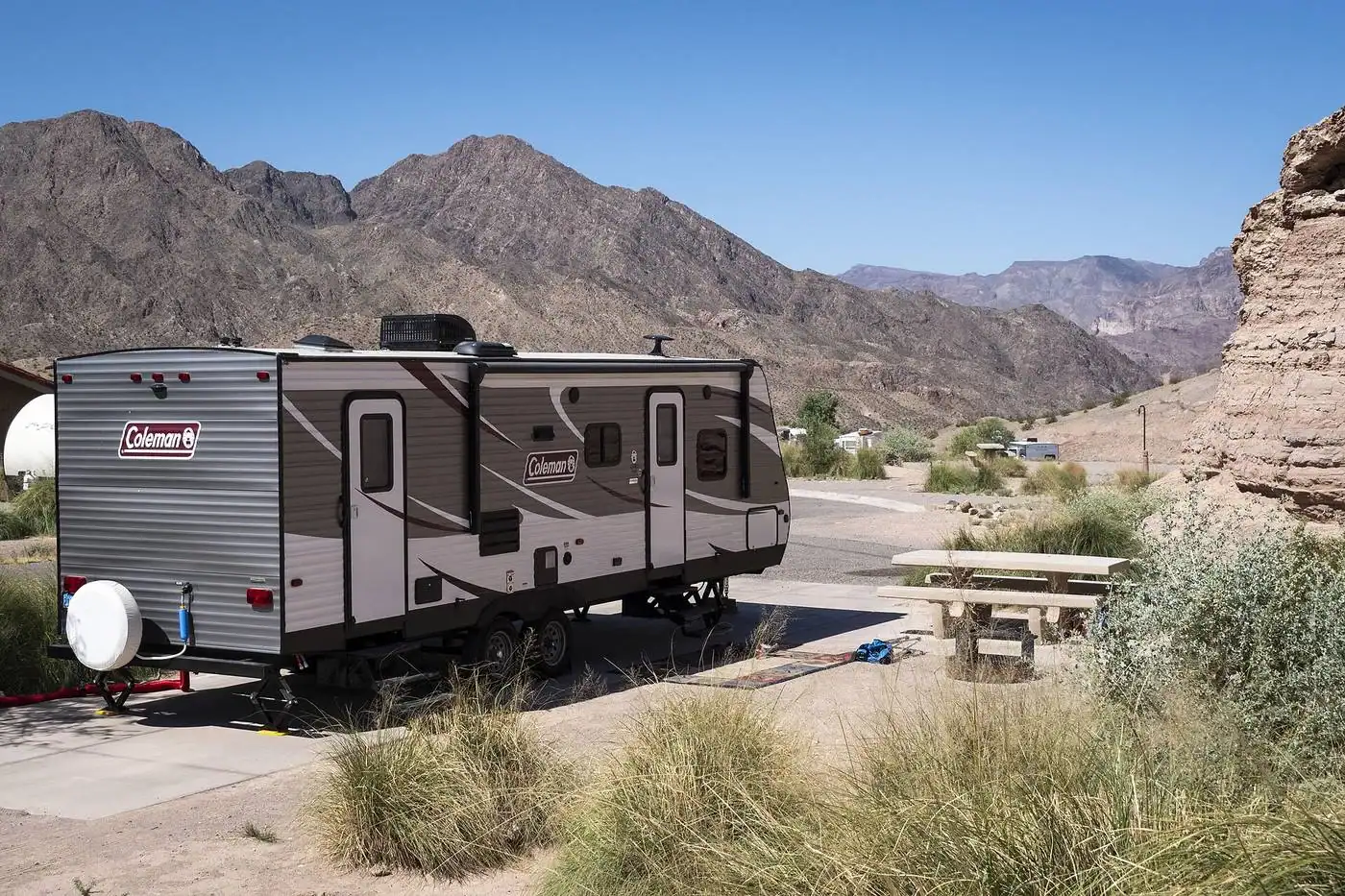
This guide is the detailed companion to our earlier overview, Can you pull a boat behind an RV? Here we quote what each state’s statute actually says, show how to work out your real towing limit from the RV’s ratings, and finish with a hitch-up checklist.
Double towing vs. triple towing: what the terms mean
RV owners use these words loosely. State laws don’t use them at all. Statutes count the number of units or vehicles coupled together, so that is the clearest way to think about it:
| Setup | Units in the combination | What people usually call it |
|---|---|---|
| Motorhome + boat trailer | 2 | Towing a boat behind an RV (sometimes called a double tow) |
| Pickup + travel trailer or fifth wheel | 2 | Normal towing |
| Pickup + fifth wheel or travel trailer + boat trailer | 3 | Double towing or triple towing (the same thing) |
| Motorhome + car + boat trailer | 3 | Double towing or triple towing |
If your setup has two units, the questions are length and weight. If it has three, check first whether the state allows a three-unit combination at all.
Double towing laws by state (verified at the source)
We read each statute below on the state legislature’s or DMV’s own website in November 2026. These rules change, so click through before a trip. We did not add states we haven’t verified ourselves.
| State | Three units (pickup + RV trailer + boat)? | Max combination length | Key conditions in the law |
|---|---|---|---|
| Arizona | Yes, with conditions | 65 ft | The middle unit must have a fifth wheel and brakes and weigh at least as much as the rear unit. A rear unit of 3,000 lb or more gross must have brakes. The towed units’ combined gross weight may not exceed the towing vehicle’s manufacturer-stated GVWR (A.R.S. 28-1095). |
| California | Not with a basic Class C license | 65 ft (cities may post 60 ft) | The DMV says a Class C license lets you tow “a single vehicle.” No passenger vehicle may tow more than one vehicle (CVC 21715). Length: CVC 35401. |
| Colorado | Yes | 70 ft | No combination may have more than four units or exceed 70 ft overall (C.R.S. 42-4-504(4)). |
| Florida | No | 65 ft | A noncommercial combination “may consist of no more than two units coupled together” (F.S. 316.515(3)). |
| Michigan | Yes, pickup + fifth wheel only | 75 ft | The pickup’s towing rating must be at least the weight towed, and its fifth wheel must be a recreational living unit. The extra trailer can’t weigh more than the empty pickup or the empty fifth wheel. Locking safety chains are required (MCL 257.721(5)). |
| Minnesota | Yes, with conditions | 70 ft | The tow vehicle must be a full-size pickup or recreational truck-tractor rated for all the towed weight. The driver must be 18 or older, and the trailer may carry watercraft and similar recreational items. No towing in the seven-county Twin Cities metro 6–9 a.m. or 4–7 p.m. on weekdays (Minn. Stat. 169.81, subd. 3c). |
| North Carolina | No | 60 ft | No combination may have more than two units or exceed 60 ft, bumpers included (G.S. 20-116(e)). |
| Texas | Read the statute carefully | 65 ft | Up to three vehicles may be coupled if the combination is 65 ft or less (Transp. Code 621.205(a)). However, a “passenger car” (any motor vehicle designed for 10 or fewer people) weighing 2,500 lb or more may tow a towing device plus one other vehicle (621.205(c)). Ask Texas DPS how that applies to your truck. |
| Wisconsin | Yes, with conditions | 65 ft (70 ft with a fifth wheel) | The recreational vehicle goes second and the lighter unit third. If the towed weight is over 3,000 lb, one towed unit needs brakes. No three-vehicle towing in heavy snow, freezing rain, icy roads, high winds or limited visibility (Wis. Stat. 348.08(1)(i) and (j)). |
What about a motorhome towing a car and a boat?
Read the conditions closely. Arizona requires the middle unit to have a fifth wheel. Michigan’s exception covers only a pickup with a fifth-wheel RV. Minnesota’s covers a full-size pickup or a recreational truck-tractor. A motorhome pulling a car and then a boat doesn’t fit any of those three exceptions. Colorado’s general four-unit, 70-foot rule is the broadest of the states we checked.
Crossing state lines
Your rig must be legal in every state you drive through, not only in your home state. A pickup, 30-foot fifth wheel and boat that is fine in Michigan at 75 feet would be over the limit in North Carolina, and it isn’t allowed as a three-unit combination in Florida at all. Plan the route around the strictest state on it.
How towing weight ratings work
Legality is only half of it. The other half is what the RV, the hitch and the trailer are rated to handle. These are the numbers to find:
| Rating | What it means | Where to find it |
|---|---|---|
| GVWR (Gross Vehicle Weight Rating) | The maximum the vehicle or trailer may weigh fully loaded | Federal certification label; on trailers, the forward half of the left side |
| GCWR (Gross Combined Weight Rating) | BoatUS: “the total weight of the car, trailer, boat, passengers, and gear” the tow vehicle can safely handle | Owner’s manual or the RV maker’s spec sheet |
| Hitch rating | Maximum trailer weight and tongue weight for the receiver | Label on the hitch and the RV spec sheet |
| GAWR (Gross Axle Weight Rating) | Maximum load on each axle | Certification label |
| OCCC / CCC | Motorhome Occupant and Cargo Carrying Capacity, or Cargo Carrying Capacity on RV trailers | Label on the inside of the forward-most right-side door (FMVSS 120) |
BoatUS lists four trailer hitch classes by the weight they will pull:
- Class I: up to 2,000 lb
- Class II: up to 3,500 lb
- Class III: up to 5,000 lb
- Class IV: up to 10,000 lb
BoatUS adds that the weight of the boat, trailer and gear “should never exceed this capacity.” On a motorhome, the hitch rating printed by the RV maker is the one that counts, even if the receiver looks bigger.
The RV label most owners overlook
Federal Motor Vehicle Safety Standard 120 requires motorhome makers to post a label reading “THE COMBINED WEIGHT OF OCCUPANTS AND CARGO SHOULD NEVER EXCEED” a stated number. The rule also says on-board fresh water counts as cargo. A full fresh tank, people, food and gear all eat into the same budget, before you hitch anything up.
Worked examples from real RV spec sheets
These are two current Jayco motorhomes, with figures taken from Jayco’s own 2026 spec flyers:
| Model (2026) | Chassis | GVWR | GCWR | Hitch rating | Length | Fresh water |
|---|---|---|---|---|---|---|
| Jayco Greyhawk 29MV (Class C) | Ford E-450 | 14,500 lb | 22,000 lb | 7,500 lb, 750 lb tongue | 32′ 6″ | 47 gal |
| Jayco Precept Prestige 36B (Class A) | Ford F53 | 24,000 lb | 30,000 lb | 5,000 lb | 38′ 8″ | 72 gal |
Step 1: Subtract the RV’s real weight from the GCWR
If the Greyhawk is loaded right up to its 14,500-lb GVWR, then 22,000 − 14,500 leaves 7,500 lb for a trailer, which matches its hitch rating. If the Precept Prestige is loaded to its 24,000-lb GVWR, then 30,000 − 24,000 leaves 6,000 lb. Its hitch is rated for only 5,000 lb, though, so 5,000 lb is the real limit. Always use the lowest of the numbers.
Step 2: Add up the boat side honestly
BoatUS says to count the boat, engine, gasoline at about six pounds per gallon, water at about eight pounds per gallon, and gear. It also notes some experts suggest keeping the load to no more than 85% of the trailer’s GVWR. For example, a Boston Whaler 210 Montauk weighs 3,650 lb with engine, fuel and water, according to Boston Whaler. Add the trailer and your gear on top of that. Our article on how much a center console boat weighs walks through this in detail.
Step 3: Check tongue weight
Nissan’s 2025 Towing Guide suggests tongue load of 10–15% of total trailer weight. A 4,500-lb boat-and-trailer package works out to roughly 450–675 lb at the ball. That is inside the Greyhawk’s 750-lb tongue rating, but the tongue weight also counts against the motorhome’s cargo capacity. A scale like the Sherline LM-2000 tongue weight scale lets you measure instead of guess.
Step 4: Check length
The Precept Prestige is 38′ 8″ long. In North Carolina, with a 60-foot limit, that leaves about 21 feet for the hitch gap, the trailer tongue and the boat, outboard included. In Florida or Arizona, with 65-foot limits, you’d have about 26 feet. Measure your actual rig from the front bumper to the farthest point at the back.
Prefer to do this on paper? Our loaded boat trailer tow worksheet lays out the same math.
Hitch-up and safety checklist
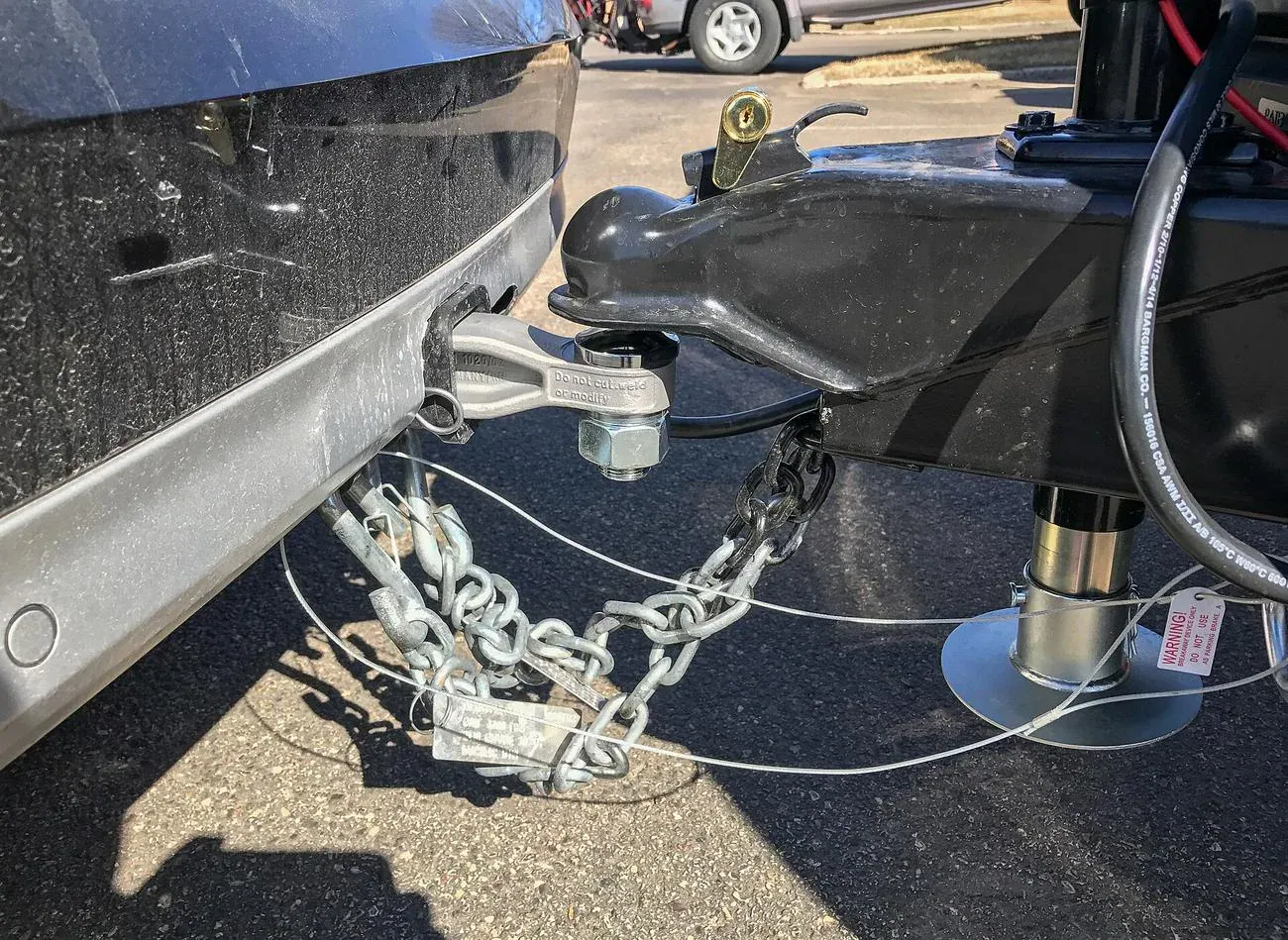
- Cross the safety chains. BoatUS: always use safety chains “criss-crossed between the car and the trailer coupling,” with enough slack for turns but not so much that they drag. Michigan’s double-tow rule also requires locking chains on the extra trailer.
- Brakes. Arizona requires brakes on a rear unit of 3,000 lb or more in a three-unit tow, and Wisconsin requires them on one towed unit once total towed weight passes 3,000 lb. Brake rules for a single trailer vary by state; see our guide on whether your boat trailer needs brakes.
- Heavier unit in front. Arizona and Wisconsin both put the heavier towed unit in the middle and the lighter one at the back. That’s a sound rule even where it isn’t written into law.
- Tongue weight and sway. BoatUS warns that too little weight on the ball makes the trailer prone to fishtailing. Soft tires or too much weight for the tow vehicle can cause it too.
- Tires. Check pressures cold before you leave. On a long trip, a tire monitor such as the TireMinder i10 RV TPMS with 4 transmitters lets you watch the trailer tires from the cab.
- Weather. Wisconsin bans three-vehicle towing in heavy snow, freezing rain, icy roads, high winds and limited visibility. Those conditions are a good reason to wait anywhere.
- Lights. Test brake lights, turn signals and running lights on both trailers before every leg.
- Tie-downs. BoatUS advises not relying on the winch cable alone at the bow, and checking straps whenever you stop.
Frequently asked questions
Is it legal to tow a boat behind a motorhome?
Yes. A motorhome and one boat trailer is a two-unit combination, which every state we checked allows. Stay within the state’s overall length limit, such as 60 ft in North Carolina and 65 ft in Florida, Arizona, Texas and California, and within the RV’s hitch rating and GCWR.
Which states allow triple towing?
Among the states we verified, Arizona, Colorado, Michigan, Minnesota and Wisconsin allow a three-unit recreational combination, each with its own conditions. Florida and North Carolina limit you to two units. California generally doesn’t allow it on a basic license, and the Texas statute should be checked against your specific tow vehicle.
Do I need a special license to double tow?
It depends on the state and the weights. In California, a Class C license covers towing a single vehicle; the DMV lists a noncommercial Class A for a fifth-wheel travel trailer over 15,000 lb GVWR or a trailer coach over 10,000 lb GVWR. Check your home state’s DMV for its rules.
Can I tow a car and a boat behind my motorhome?
In most of the states we checked, no. The three-unit exceptions in Arizona, Michigan and Minnesota are built around fifth wheels or pickups. Colorado’s four-unit, 70-ft rule is the broadest.
How much boat can my RV tow?
Take the lowest of three numbers: GCWR minus the RV’s actual loaded weight, the hitch’s trailer rating, and the trailer’s own GVWR. On a 2026 Jayco Precept Prestige, the 5,000-lb hitch rating is the limit even though the GCWR math allows more.
Safety note
This article summarizes state statutes as published in November 2026 and is not legal advice. Laws, definitions and license rules change. Before a trip, check each state on your route through its DMV, state police or state transportation department. Never exceed any weight rating on your RV, hitch or trailer, even if the math on another rating looks fine.
Sources
- Arizona Revised Statutes 28-1095 (vehicle length; RV pulling two units): azleg.gov ARS 28-1095
- California Vehicle Code 21715: leginfo.legislature.ca.gov CVC 21715
- California Vehicle Code 35401 (combination length): leginfo.legislature.ca.gov CVC 35401
- California DMV, Driver’s Licenses (Class C towing; noncommercial Class A): dmv.ca.gov driver licenses
- Colorado Revised Statutes 42-4-504 (statute text): C.R.S. 42-4-504 (Justia); Colorado General Assembly, Size and Weight Limitations: leg.colorado.gov
- Florida Statutes 316.515: flsenate.gov
- Michigan Compiled Laws 257.721: legislature.mi.gov MCL 257.721
- Minnesota Statutes 169.81: revisor.mn.gov 169.81
- North Carolina General Statutes 20-116: ncleg.gov G.S. 20-116
- Texas Transportation Code Chapter 621 (621.203, 621.205): statutes.capitol.texas.gov TN 621
- Wisconsin Statutes 348.08: docs.legis.wisconsin.gov 348.08
- 49 CFR 571.120, FMVSS 120 (RV load carrying capacity labels): ecfr.gov 49 CFR 571.120
- 49 CFR 567.4 (certification labels, GVWR/GAWR): ecfr.gov 49 CFR 567.4
- Jayco, 2026 Greyhawk spec flyer: jayco.com (PDF)
- Jayco, 2026 Precept Prestige spec flyer: jayco.com (PDF)
- BoatUS Foundation, Transportation & Trailering: boatus.org
- Nissan, 2025 Towing Guide (tongue load): nissanusa.com (PDF)
- Boston Whaler, 210 Montauk specifications: bostonwhaler.com